



How Will the 'Cliff' Aversion Drive Truck Value?
A look back over the past decade may shed some light on what to expect from the recent fiscal crisis. Overall, Black Book anticipates a positive impact on values.
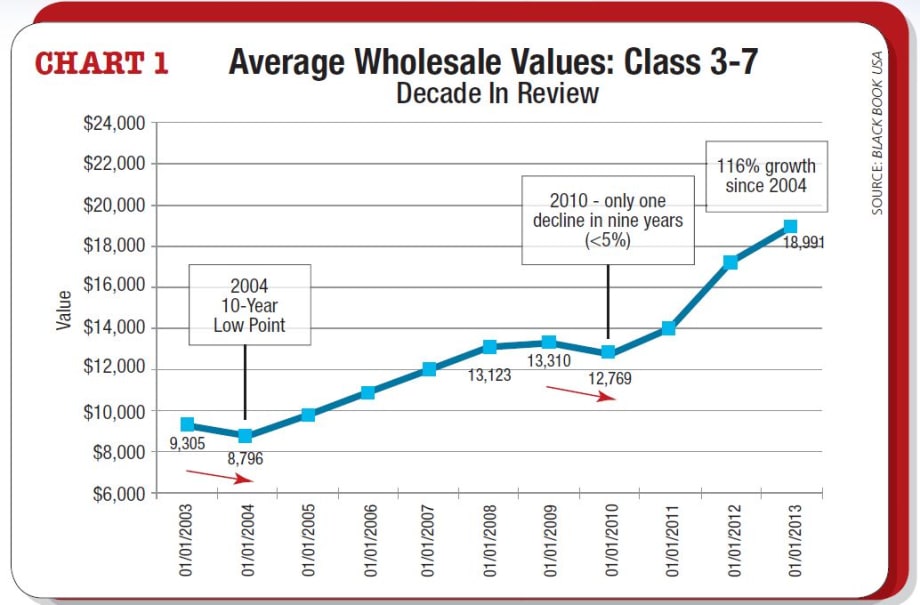
Despite the economic challenges over the past nine years (2004 to present), there has been a more than 116-percent growth in average Class 3-7 truck wholesale values. 2010 was the only decline during this period, which was a drop of less than 5 percent.
Source: Black Book
It is often said, as the economy goes up, so does the automotive and trucking industry. The reverse can also be true. The past four to five years have definitely proven this to be the case.
As the construction industry across the country in both residential and commercial was pummeled by the recession, the need for additional or replacement trucks in the medium-duty segments dropped as a result. New truck orders and subsequent sales became almost non-existent.
Within the Class 3-7 used market, no new sales meant very few trade-ins and eventually an extremely tight supply of two- to eight-year-old used trucks within the wholesale arena. Fortunately, the demand for new and used trucks was less than during traditional times.
Looking Back at the Past Decade
So, how have medium-duty Class 3-7 used-truck values been tracked over the past few years and even on a longer period, say, over the past nine to 10 years? From all of the data gathered and analyzed by Black Book in tracking used medium-duty trucks, the most popular age and length of in-service vehicles being traded is much longer than the car market.
Medium-duty trucks tend to stay in service longer and incur higher mileage before the initial trade-in or replacement process begins.
As a benchmark, Black Book focuses on the four- to 10-year-olds for consistency and better volumes.
Looking back over the past 10 years, the average used-truck price has shown an almost unbelievable increase in value. This has been driven by the need for a quality product, which generally has newer and better technology and improved durability with regard to service needs. And, more recently, the end-users hesitancy to commit to and purchase new, costlier units.
Looking back at the Jan. 1 average used values of four- to 11-year-old medium-duty trucks, the $9,305 average price dropped by almost 5 percent to a 10-year low of $8,796. For the next nine years, the average price increased all but one year, from 2009 to 2010 — the same period when the new sales levels bottomed out, and right amid the economic downturn.
That just-under 5-percent drop in value was only a slight blip in the value trends with significant value increases from January 2011 to January 2012, and, ultimately, into January 2013.
From 2004 through the present, there has been a more than 116-percent growth in a very short, economically challenged nine years. Used-truck demand and emissions-mandated new technology on the coming new models had the end user scrambling for good used product. (See Chart 1.)
Taking a look at the most recent two-year value pattern of change, when the dollar change was the greatest, the market wasn’t just a steady decline of value growth.
Some of the more noticeable increases in average value have shown up when the next newer model-year was added to the comparison table in August of each year. (See Chart 2.) The only real significant decline in more than two years was the time period from October 2012 to January 2013. Will this trend continue?
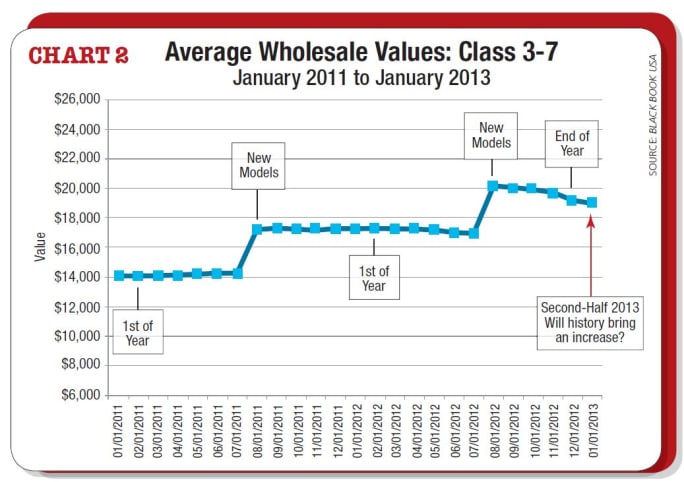
Average wholesale values tend to increase slightly at the start of each calendar year, as shown in 2011 and 2012. If history repeats itself, there will be a slight increase in Class 3-7 wholesale values as we head into 2013. However, this trend may not last long.
Source: Black Book
If history repeats itself, we will see a slight increase in values as we head into February. But, I wouldn’t bet the farm on this trend continuing, or at least not at this level.
The price of diesel fuel continues to be one of the greatest challenges and most looked-at factors within the costs of the trucking and construction industries. For all of 2012, the national average diesel price at the pump per gallon came in at $3.97, which was 13 cents higher than the 2011 average of $3.84.
The volatility throughout the past year ranged from a low of $3.65, with two separate periods at $4-plus per gallon on three occasions in March, April, and October. For all of 2012, the average price came in at $3.95, which was 11 cents above the 2011 average of $3.84.
With fuel price such an important factor in operating costs, the push to go “green” may be driven by factors other than lower CO2 emissions. There’s talk everywhere of liquefied and compressed natural gas (LNG and CNG), hybrids, and electric drivetrains. In the September/October 2012 issue of Work Truck, at least seven articles and/or advertisements openly mentioned LNG- or CNG-fueled engines.
Those affected by this fuel source are mostly small fleets running natural gas-powered vehicles (NGVs) and many have been doing so for several years. Many of these fleets are getting into this source of power by purchasing these units from the used market, often through GSA sales.
This allows fleet customers to take advantage of local, state, and federal tax credits and also utilize HOV lanes. When purchasing new, the additional $10,000-$12,000 takes a little more time to balance the ROI.
Range, along with a solid infrastructure for refueling, presents challenges that are also factors somewhat stalling the growth for electric (EVs) and plug-in hybrid-electric vehicles (PHEVs) within the automotive market.
Even with tax incentives on the automotive side, sales levels/penetration of hybrid-electric and pure electric vehicles are still struggling at a 3-percent level.
Within the medium-duty truck market, the percentage of NGVs is even less, with the majority of those fitting in the bus market or Class 3 models, but still gradually growing.
Within the overall medium-duty truck market, the best retention value always appears on the properly equipped models. Depending on the service needs, all new trucks are not equipped to fit a broad used-truck market. Currently, there is a better supply of some Class 6 box trucks that meet the new buyer’s usage needs, but due to floor and height construction of the box, the used market is more limited. These vehicles would sell much more quickly, and for a greater value, with just an extra cross member or two and an extra 12 to 18 inches of inside height.
Starting the New Year Off Positive
So, what is there to expect in market values and activity during the first half of 2013 within the medium-duty market?
Within the Black Book data, the primary drivers of market values are always supply and demand and the balance of the two.
Following the devastating damage caused by Hurricane Sandy in October 2012, the positive for the trucking and construction industry is that there is demand necessitated by this destruction. The potential for solid retention value due to this bump in demand is the best for this time period because of the volume of sales over the past four years. From more than 303,000 medium-duty truck sales seven years ago, to the bottom in sales of 128,000 in 2009, climbing steadily to an estimated 180,000 for 2012, the supply is tight enough with this short-term demand to hold values fairly stable. (See Chart 3.)
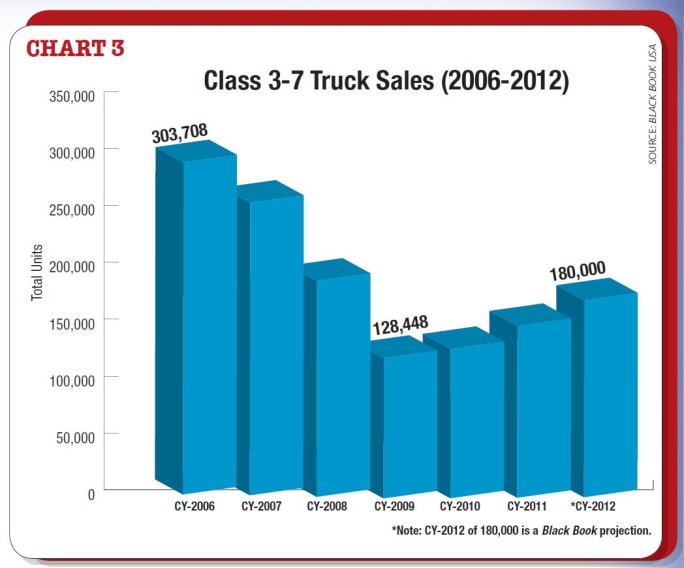
Supply and demand and the balance of the two are the primary drivers of market values. The destruction on the East Coast resulting from Hurricane Sandy is driving up short-term demand and the supply is tight enough to hold values fairly stable.
Source: Black Book
With the fiscal cliff aversion, encouraging signs of economic improvement, and more consumer and floor plan money available, the indicators are more positive than they’ve been in a long time. Over the past few years, many dealers have been running extra lean operations due to less business and future economic uncertainty. As signs of improvement arise, we could see more active efforts in acquiring used trucks, and in many cases, newer used trucks and equipment.
Black Book is constantly monitoring wholesale auctions and additional market activity. The electronic Internet suite, recently upgraded for the medium- and heavy-duty truck market, along with the handheld mobile products are user-friendly to provide the most informative market and value information.
What is the top maintenance-related factor to worry about when resale is on your mind? What should you avoid spending money on? What matters the most? Learn how to maintain your work trucks with resale in mind!
Originally posted on Work Truck Online
More Used Vehicle Values
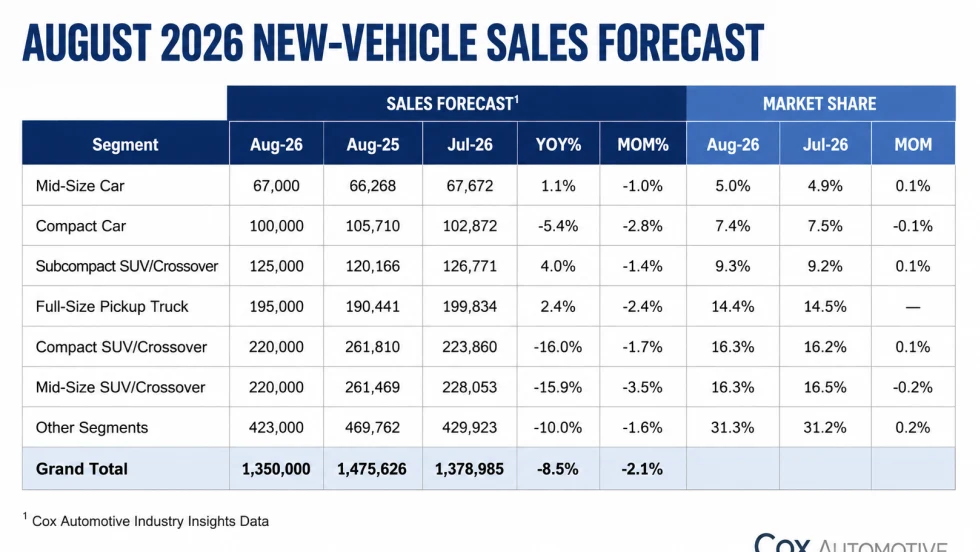
August New-Vehicle Sales Pace Forecast to Hold Above 16 Million
Despite an expected 8.5% year-over-year decline in August volume, Cox Automotive forecasts a 16.3 million SAAR, with full-size pickups outperforming several major crossover segments.
Read More →
Trade Strategy Now Starts Long Before Turn-In
The strongest trade values aren't built at turn-in. Discover how maintenance, lifecycle planning, and shared risk protect truck resale value.
Read More →
What Happens When Residual Values Meet Real-World Markets
A truck's trade value isn't determined on turn-in day. Learn how market cycles, maintenance, and timing shape the gap between residuals and reality.
Read More →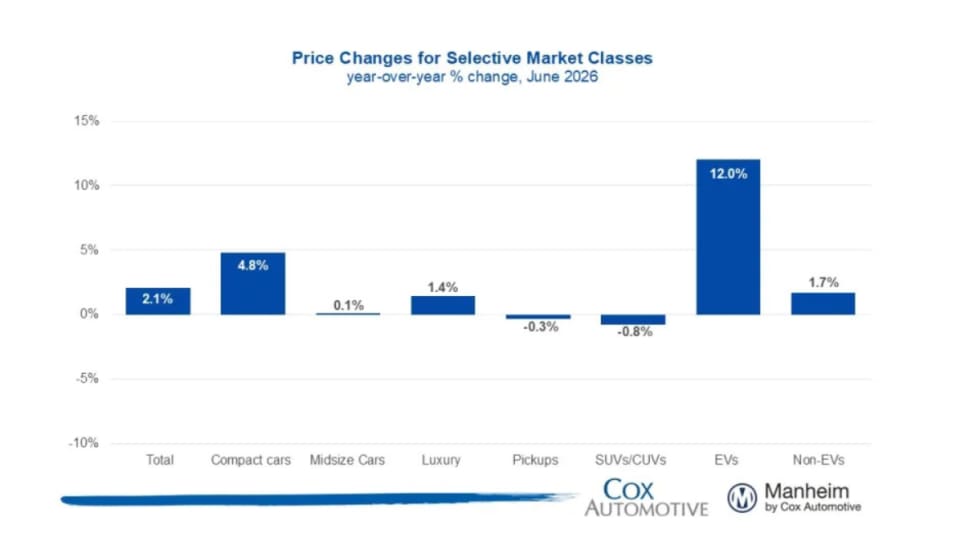
Manheim Index Shows Used-Vehicle Wholesale Prices Up 2.1% in June
The market is seeing stronger appreciation in older used vehicles this year, and the most affordable segments have been among the year’s best performers.
Read More →
Stop Remarketing Electric Vehicles Like Gas Cars
The advantages and attributes of electric vehicles are upending the traditional remarketing cycle, requiring fleet sellers to rely on new factors and approaches detailed below.
Read More →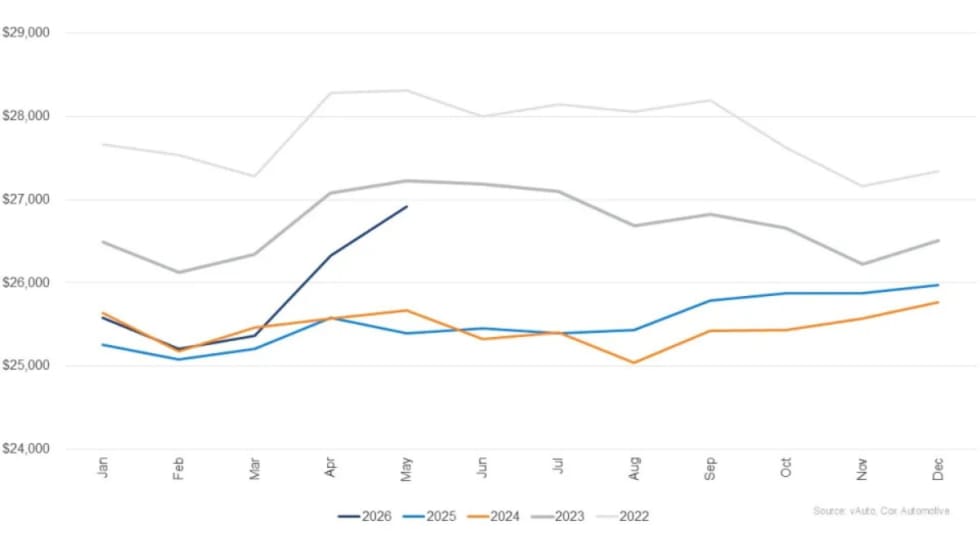
Used Vehicle Prices Climb Higher As Sales Pace Slows
The higher prices at used retail reflect strong wholesale values earlier in the spring, particularly for older, more affordable vehicles.
Read More →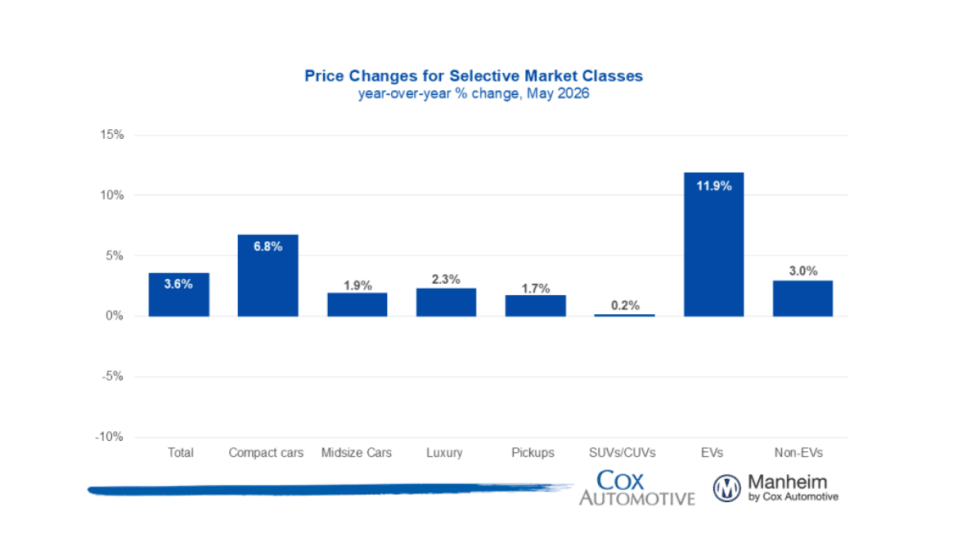
Wholesale Used Vehicle Market Sustains Moderate Rise In Values, Prices
Trends continue to normalize after a strong start to the year, as consumers contend with higher gas prices in the coming summer months.
Read More →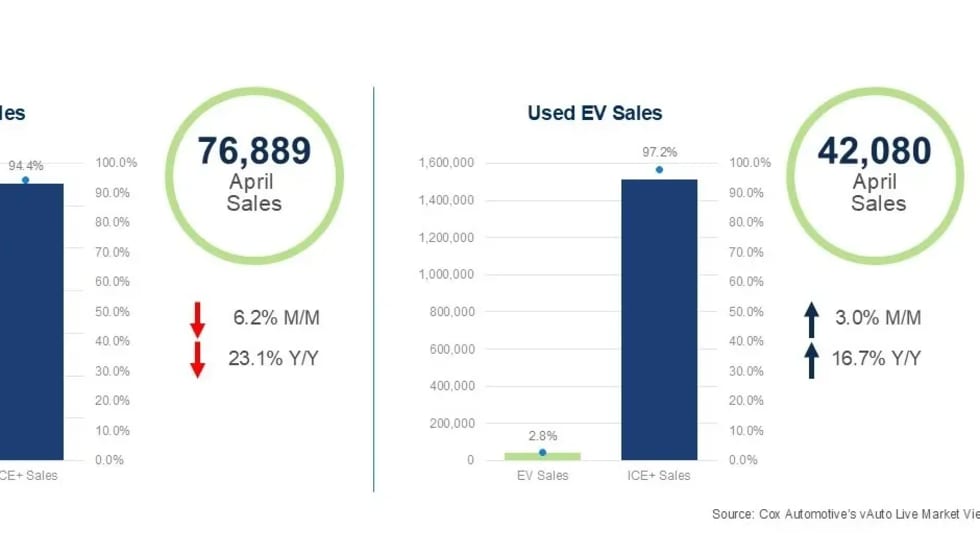
Used EV Sales Grow In April
While EV sales declined, used EV sales grew, as tighter inventory and rising prices reflected a more normalized pace for the EV market.
Read More →
Wholesale Used Vehicle Prices Slightly Up In April
The Iranian conflict and rising gas prices inject much uncertainty into the future wholesale used vehicle markets, as higher gas prices soak up spendable income from vehicle buyers.
Read More →
CAR 2026 Recap Part 2: Closing the Gap Between Data & Remarketing Value
The second half of CAR 2026 examined how fleets can translate lifecycle strategy, vehicle data, and market shifts into higher real-world results.
Read More →