




JD Power @ 2024 CAR: Mixed Messages On Vehicle Values
New, Used Vehicle Markets Solid but Facing Tariff Uncertainty
CAR 2025: A JD Power expert ties together the leading automotive sales and supply trends among vehicle buyers facing the disruptions of impending tariffs this month.
April 2, 2025

David Sargent, vice president of global automotive for J.D. Power, delivered a data-focused presentation on the automotive remarket on March 19 during the Conference of Automotive Remarketing in San Diego.
Photo: Ross Stewart / Stewart Digital Media
8 min to read
As the automotive market encounters intersecting economic forces and data streams, it needs to brace itself for the big T-bone collision: tariffs.
Just as the new and used vehicle sectors continue to show a slow-motion solid rebound from the 2020 pandemic upheavals, the post-April 2 tariffs whammy likely introduces unknown variables and consequences, according to a JD Power session at the Conference of Automotive Remarketing in San Diego.
It was the third year in a row that JD Power provided insights at the event, which attracts the employees and leaders of fleet consignors, auto auctions, auto dealers, and auto finance companies.
During a broad and info-rich presentation on March 19, JD Power vice president David Sargent drew upon data from about 40%+ of all U.S. retail vehicle transactions the company tracks. He offered the following key points and comments:
New Vehicle Market Overview
The new vehicle market has seen a significant improvement in sales, particularly in Q4.
Production for the U.S. market last year was about 16.5 million units, with total sales of 16 million and 500,000 unsold vehicles in dealer inventory.
OEMs tend to overestimate vehicle sales at 110% of the market, leading to excess inventory and increased incentives to move vehicles.
Impact of Incentives and Dealer Profit Margins
Incentives have risen significantly, with OEMs spending $3,300 per vehicle on average by the end of last year.
Dealer profit margins have taken a hit, with post-COVID profits dropping from over 11% to around 4%. Dealer profits dropped from $40 billion in 2023 to $28 billion in 2024.
Average monthly loan payments for new vehicles have increased from $590 in 2017 to $756 in 2024, driven by higher prices and smaller down payments.
Total consumer expenditure on new vehicles in 2024 was $580 billion, the highest ever, despite lower dealer profits.
“Everything we're seeing is the industry making a pretty consistent and, in some cases, gradual move back to pre-COVID conditions,” Sargent said. “It’s the market we sort of know and love. Although prices of new vehicles softened last year, what people are paying has gone up.”
Sargent pointed out that while car prices have risen in the last few years amid higher interest rates, buys are not able to put as much money down as before.
“A lot of people are coming back, and they're either upside down on their trade-in or they have very little equity in their vehicle,” he said. “The have higher monthly payments because they simply don't have enough of a down payment to reduce the monthly payment.”
Despite this, consumers are buying more vehicles and spending a lot of money, he said.
Most of the increase in vehicle sales is driven by retail, not fleet. “The OEMs, although they were building more and stopping inventory, they weren't dumping vehicles into fleets and rental like they had been in the past.
Retail Sales and Fleet Sales
Retail sales have driven the increase in sales, with fleet sales remaining relatively stable.
Dealers' total profit from new vehicle sales dropped from $40 billion in 2023 to $28 billion in 2024.
2025 is expected to see the strongest February for new vehicle sales since 2017, with retail sales up to 13.1 million.
Transaction prices are expected to continue declining, with incentives increasing to drive sales.
The outlook for 2025 is new vehicle sales will rise to 16.3 million, coming mostly from retail and off-lease. That means higher incentives and lower transaction prices.
Tariff Uncertainties and Their Impact
Tariffs remain a significant unknown, potentially impacting new vehicle sales and prices.
If tariffs expand to major vehicle-producing markets such as the EU, U.K., Japan, and South Korea, the worst-case scenario could result in a 2.3 million-unit hit to new vehicle sales.
Different OEMs are exposed to tariffs differently, with Toyota and Chevrolet being the most affected.
OEMs may spread the cost of tariffs across their vehicle lineup to avoid significant price increases on specific models.
“Anybody who says they know what's going to happen in 2025 is lying to you.” Sargent said. At most, analysts can make best guesses that are more uncertain than in past years, he said.
“Tariffs in, and tariffs out: How much will they be? Will they be on parts? Will they be on total sales? Will they be on added value? What countries are involved? When will they start?
“If there's basically a 25% tariff on all new vehicle coming into the market, there could be a massive hit on new vehicle sales,” Sargent said. “Not surprisingly, price go up, and people are less likely to buy. But there are many factors that have not yet been determined: What's the final scope of tariffs? When will they actually start? How will the OEMs respond? They may or may not respond by passing all the cost on to consumers. Different OEMs will react differently. What percentage of that tariff will be passed through to consumers? Nobody knows.”
As examples, Sargent cited what percentage of OEMs’ vehicle values and compositions sold in the U.S. are imported: Toyota, 48%; Chevrolet, 58%, and Hyundai, 66%. Lexus has the highest percentage of non-U.S. vehicle production value, at 79%.
Meanwhile, Ford is the least exposed of all the major OEMs in terms of how much of their volume comes from abroad. 76% of Ford value is built in the U.S., leaving them the least vulnerable automaker to tariffs.
Among vehicle categories, small SUVs and compact cars, generally the most affordable new vehicles, have the most tariff exposure to foreign production sources, at 78% and 79% respectively.
OEMs will decide individually how to spread out the tariff cost burdens among their vehicle models, whether certain models are tariffed or not, Sargent said. Moving more production to the U.S. is a long-term project that lasts much longer than four years.
“Who knows if the tariffs will continue? No one will start building a factory if they don't think the tariffs will last for a long, long time. And four years, frankly, is not long enough to make that decision. So the OEMs are in a difficult position in knowing what to do in their production.”
Used Vehicle Market and Consumer Behavior
Used vehicle prices are off their peak but still well above pre-COVID levels, with used vehicle profitability down from $4,000 to $2,600 per vehicle. Profits are continuing to flatten and trend down to pre-COVID levels.
The supply of used vehicles remains tight, particularly in segments like compact cars and mid-sized cars, leading to high monthly payments for used vehicle buyers.
New vehicle incentives and increased supply are expected to drive down used vehicle prices, with a forecast of a 3% year-over-year decline.
Consumers with high-interest rate loans from 2021 and 2022 are expected to have less equity in their vehicles, making it harder for them to return to the market.
“The market is starting to return to what we're used to, but it's not there yet,” Sargent said. “Used vehicle prices are still high. Used profitability is well below its peak.” But tight supply in used vehicles will continue to generate higher average monthly payments for the coming year.
“What will consumers be able to afford? Again, lot of uncertainty due to tariffs. If we don't really understand what they will do to the new market, it’s even harder to explain what they will do to the to the used market.”
Increased incentives on new vehicles drive lower prices on used ones, Sargent said, so a forecasted increase of about $1,100 in incentives on new vehicles this year would translate into about 50% of incentive amounts factoring into lower used vehicle prices.
“Used vehicles remain a key source of profit for dealers. As they make less and less money on new vehicles, they will make more money on new vehicles, and that won’t be easy. Supply will be tight. Vehicles will be hard to find. A big drop off-lease returns will generate more buyer competition for those vehicles, he added.
Quality of Used Vehicles
The quality of the used vehicle fleet is generally good, with reliability remaining high, according to JD Power's most recent vehicle dependability study.
Consumers are increasingly concerned about the reliability and cost of EV batteries, particularly for used EVs.
Warranty costs for EVs are significantly higher than for gas vehicles, with legacy OEMs showing the highest costs.
The used vehicle fleet is expected to remain a key source of profit for dealers, despite the challenges posed by tariffs and market conditions.
“Vehicles are lasting longer than before, and they break down way less than they used to,” Sargent said. “A lot of what goes wrong on vehicles relates to the infotainment system, Bluetooth, and navigation systems. But the fundamental underlying reliability of vehicles is better than it has ever been.”
Electric Vehicle Market Dynamics, Challenges and Preferences
Consumers are more concerned about the quality and reliability of EV batteries than they are about the quality of gas vehicles.
The perception of car brands significantly influences consumers' confidence in EV batteries, with brands like Tesla and BMW being seen as more reliable.
The market for used EVs is expected to grow, driven by increasing consumer awareness and the availability of viable EV options.
The EV market is growing, but the rate of growth has slowed, with California seeing a decline in EV sales.
More consumers are finding viable EV options within their price range, but overall demand remains relatively low.
Public charging infrastructure is not keeping pace with the growth in EV sales, leading to consumer frustration. One fifth of EV users indicate an EV charger was not working the first time they tried to use one.
Consumers are concerned about the reliability and cost of EV batteries, particularly for used vehicles, and are looking for assurances from third-party providers.
Consumers are willing to pay more for used EVs with battery health checks, indicating a need for third-party verification.
Fewer than one fourth of consumers say they are very likely to buy an EV for their next vehicle, and the same percentage say they are very unlikely to buy an EV.
In 2022, the electric vehicle market offered 21 all-electric models with a 6% retail market share. In 2024, the market had 58 pure electric models, carrying 9% of the new vehicle market, Sargent said.
“Although the market is getting slightly bigger for EVs, the number of each EV model that's being sold is falling significantly. More and more EVs are coming to market, but not many consumers want them right now.” Higher available EVs mean more consumers can choose an EV.
Topics:Used Vehicle PricesNew Vehicle PricesElectric VehiclesJ.D. PowertariffsConference of Automotive RemarketingUsed Vehicle ValuesFleet
Originally posted on Automotive Fleet
More Used Vehicle Values
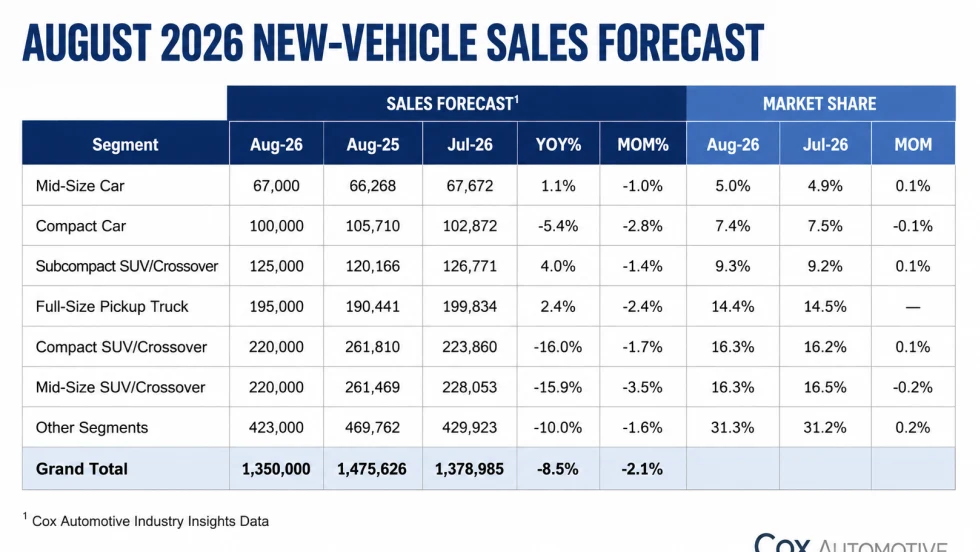
August New-Vehicle Sales Pace Forecast to Hold Above 16 Million
Despite an expected 8.5% year-over-year decline in August volume, Cox Automotive forecasts a 16.3 million SAAR, with full-size pickups outperforming several major crossover segments.
Read More →
Trade Strategy Now Starts Long Before Turn-In
The strongest trade values aren't built at turn-in. Discover how maintenance, lifecycle planning, and shared risk protect truck resale value.
Read More →
What Happens When Residual Values Meet Real-World Markets
A truck's trade value isn't determined on turn-in day. Learn how market cycles, maintenance, and timing shape the gap between residuals and reality.
Read More →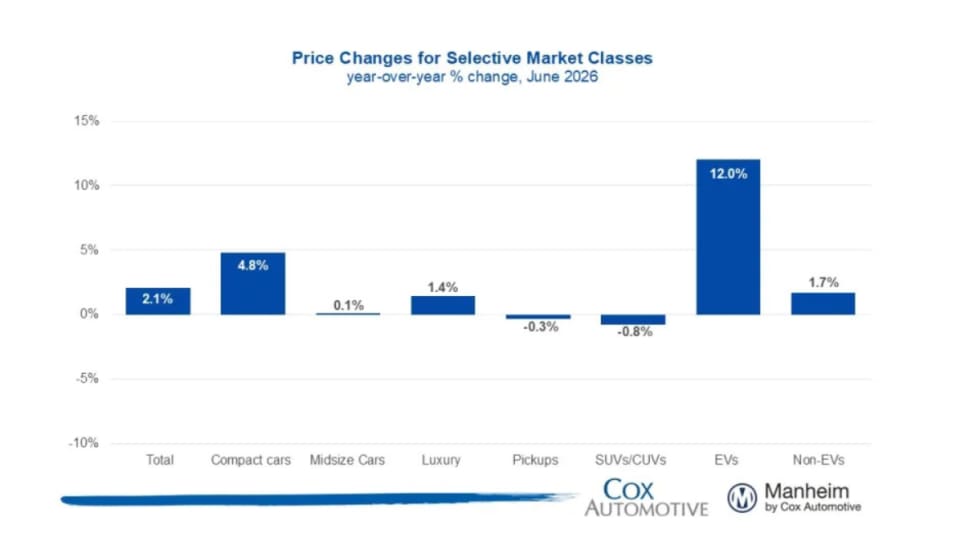
Manheim Index Shows Used-Vehicle Wholesale Prices Up 2.1% in June
The market is seeing stronger appreciation in older used vehicles this year, and the most affordable segments have been among the year’s best performers.
Read More →
Stop Remarketing Electric Vehicles Like Gas Cars
The advantages and attributes of electric vehicles are upending the traditional remarketing cycle, requiring fleet sellers to rely on new factors and approaches detailed below.
Read More →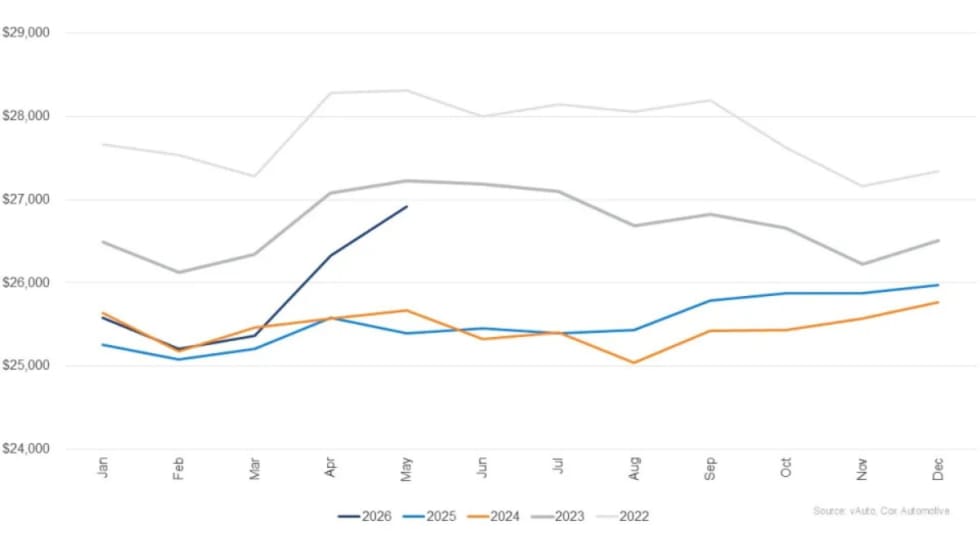
Used Vehicle Prices Climb Higher As Sales Pace Slows
The higher prices at used retail reflect strong wholesale values earlier in the spring, particularly for older, more affordable vehicles.
Read More →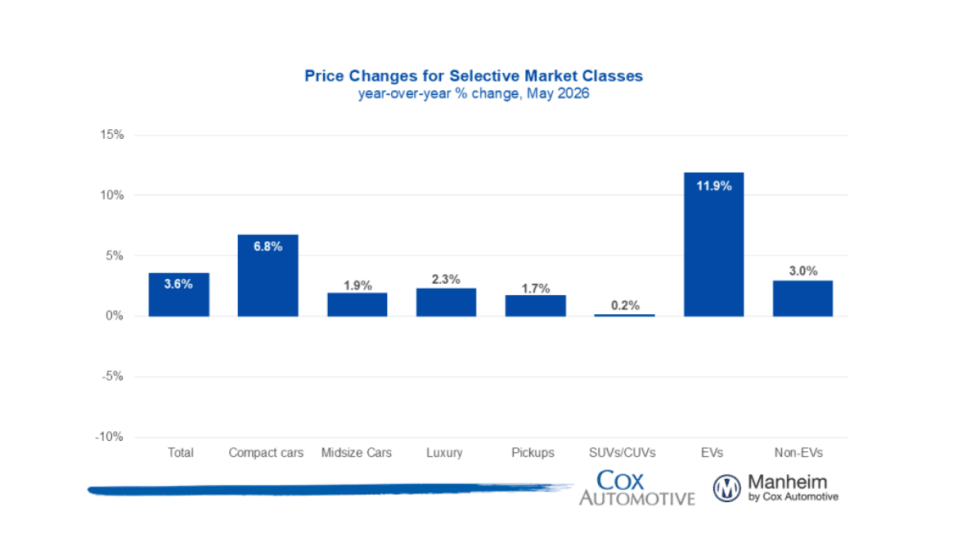
Wholesale Used Vehicle Market Sustains Moderate Rise In Values, Prices
Trends continue to normalize after a strong start to the year, as consumers contend with higher gas prices in the coming summer months.
Read More →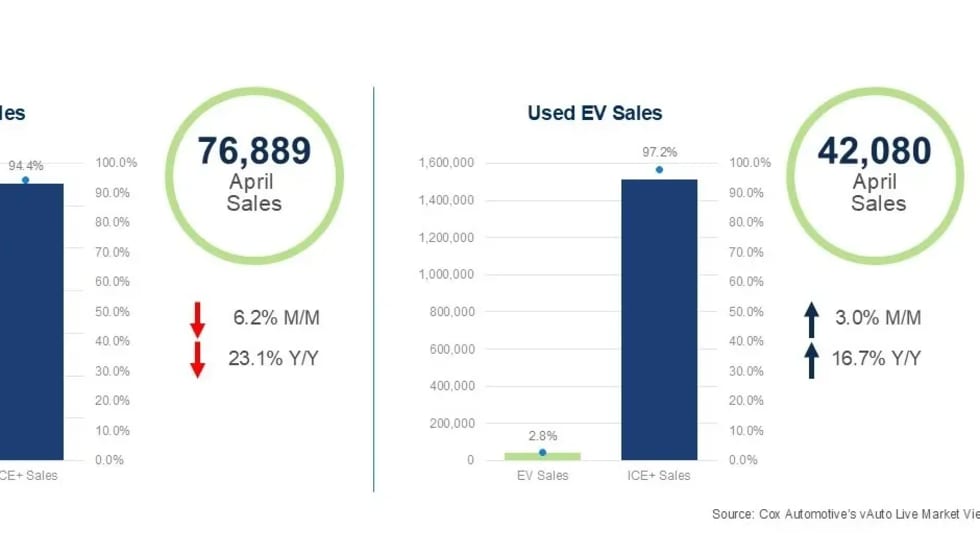
Used EV Sales Grow In April
While EV sales declined, used EV sales grew, as tighter inventory and rising prices reflected a more normalized pace for the EV market.
Read More →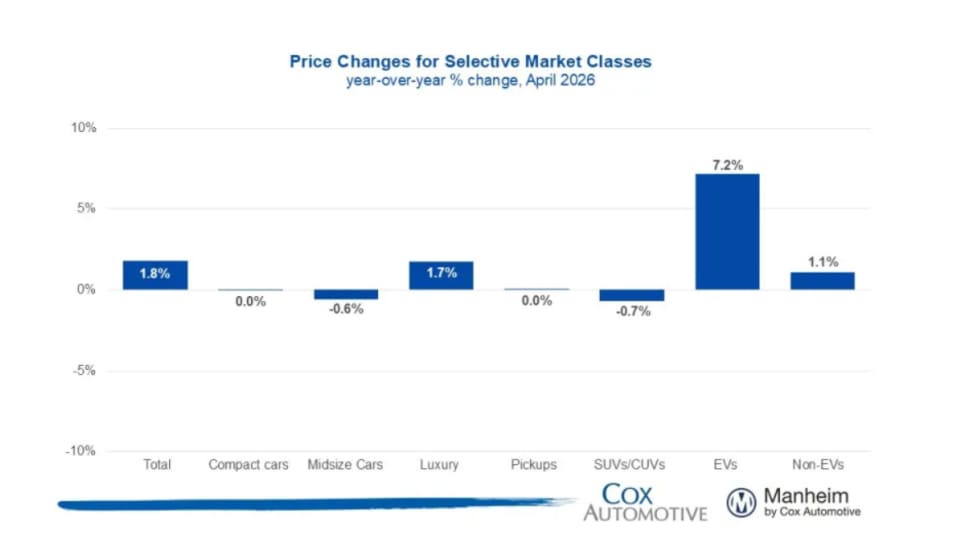
Wholesale Used Vehicle Prices Slightly Up In April
The Iranian conflict and rising gas prices inject much uncertainty into the future wholesale used vehicle markets, as higher gas prices soak up spendable income from vehicle buyers.
Read More →
CAR 2026 Recap Part 2: Closing the Gap Between Data & Remarketing Value
The second half of CAR 2026 examined how fleets can translate lifecycle strategy, vehicle data, and market shifts into higher real-world results.
Read More →