David Sargent, vice president and head of the connected vehicle practice at J.D. Power, delivers a closing keynote on the used and electric vehicles outlooks on March 30, 2023 at the Conference of Automotive Remarketing in Las Vegas.
Photo: Ross Stewart / Stewart Digital Media
6 min to read
The numbers clearly show electric vehicles accelerating into the present and future automotive markets.
A deeper dig, however, still shows a strong reluctance among U.S. consumers to buy and charge electric vehicles, indicating concerns that apply to commercial fleets as well.
Ad Loading...
In a closing keynote at the Conference of Automotive Remarketing on March 30, David Sargent, vice president and head of the connected vehicle practice at J.D. Power, offered fresh data on how electric vehicles are performing in the market and among prospective buyers.
Electric Vehicles Going Not So Fast, Yet
Sargent cited figures showing the pace of electric vehicle sales accelerating, as they reached 10% of retail vehicle sales, up from 6% last year and 3.5% in 2021.
“Yes, it's only 10%. But it's three times what it was just two years ago,” Sargent said. “It’s accelerating quickly. Most of the vehicles are pure EVs. Now, there are still a lot of people out there who are not at all interested in an EV.”
Four out of 10 consumers say they do not intend to buy an electric vehicle, compared to an internal combustion engine vehicle.
“Why is that? The number one reason, or tied with purchase price, is charging station availability. It used to be that range was the concern. Now it's where are they going to charge the EV?”
Ad Loading...
The latest J.D. Power study shows more than 20% of charging stations are not working at any one time, meaning an EV driver has a one in five chance of pulling up to an offline charger.
Top 10 Reasons for Electric Vehicle Rejection
As of February 2023:
Charging station availability: 48%
Purchase price: 48%
Range: 44%
Charging time required: 41%
Inability to charge at home/work: 36%
Cost of ownership: 34%
Power outage/grid concerns: 32%
Reliability/battery life: 25%
Lack of service centers: 22%
Performance in extreme temps: 19%
Despite such strong reluctance, the electric vehicle market is poised to expand, he said. EV sales will likely hit 14% of market share this year, and by 2026, 27% of all light vehicle retail sales will be electric. In 2030, it could be 50%.
“And a lot of this is being driven by the availability of valid EVs for people to buy,” Sargent said. “A few years ago, many people may have wanted an EV but there wasn’t anything in their segment.”
Viable Electric Vehicle Options:
2023: 50% of shoppers will have a viable EV option
2026: 75% of shoppers will have a viable EV option; 30% of shoppers will buy an EV
By the end of this year, half of all new vehicle shoppers will have an electric vehicle available to them in the segment they're buying and at the price level that they're buying, he said. By 2026, 75% of consumers will have that opportunity.
Indexing the Metrics for Electric Vehicles
Sargent cited abundant data at J.D. Power now providing deeper insights for its clients. The company is creating a J.D. Power EV Index that can pull together all data points into common metrics.
Ad Loading...
The index does the following:
Combines all essential EV data sets into a single environment
Creates critical metrics and KPIs to understand the EV world
Delivers simple user interface while making underlying vast pool of data available
Enables optimized decision making for the entire EV ecosystem
Those metrics can track stats for such questions as:
Interest: How many shoppers are truly considering EVs?
Availability: How many shoppers have a realistic EV alternative meeting their needs and budgets?
Adoption: What's the true rate of adoption?
Affordability: How affordable are EVs versus ICE alternatives?
Infrastructure: How well is the infrastructure supporting EV adoption?
Experience: How does the EV ownership experience stack up compared with ICE?
On this scale, when this number reaches 100, then electric vehicles achieve parity with internal combustion engine vehicles. As of now the score for electric vehicles is 48.7.
Ad Loading...
“We’re way off with EVs being at parity with ICE vehicles,” Sargent said. “The level of interest is still low because of availability, but it's improving rapidly. For many people there just isn’t an EV at their price point in the segment they want to buy in.”
But when you compare the affordability and true cost of ownership of the two vehicle types, it gets closer to parity, he said, citing incentive boosts from the federal Inflation Reduction Act.
The main barrier remains the infrastructure with a lack of enough charging stations. “They’re not in the right places; they are not visible.”
More than one-fourth of chargers are not working at any one time, while some of the working ones charge too slow, he said. “There’s still a long way to go with the pain factor of charging an electric vehicle publicly relative to putting gas in a vehicle. And that’s holding EVs back.”
For many consumers in non-urban areas, if they cannot charge at home, then charging becomes highly inconvenient, he said. “Infrastructure is still just dragging everything down.”
Ad Loading...
For those who’ve driven electric vehicles for an extended period, most like the performance, quiet and advanced features, he said.
“But there's a lot of things that can go wrong with electric vehicles, and most of it has little to do with the battery,” Sargent said.
Often, the infotainment systems and controls do not work consistently well. Other features and parts separate from the battery and electric system malfunction or fail, he said.
“A lot of electric vehicles are still new. Frankly, Tesla quality is not that good, and they are most of the EVs out there.”
Concerns and Fears About Remarketing
Remarketing electric vehicles presents a mix of opportunities and challenges, Sargent said.
Ad Loading...
Among top consumer concerns J.D. Power has identified: Charging, range, price, ownership costs, reliability, battery health, repair facilities, performance, and depreciation.
Those follow on to the usual concerns about used vehicles such as condition, vehicle history, warranty status, price, ownership costs, reliability, repair facilities, performance, and deprecation.
“When you add those two [categories] together, you have magnified used electric vehicle concerns,” Sargent said. “Trying to persuade the consumer to buy a used EV will be a challenge. The prospect of buying a used electric vehicle for a lot of people is quite frightening.”
From today on, almost everyone who buys a used electric vehicle will be doing so for the first time, he said. “And hardly anyone knows anyone who’s bought a used EV, if we go outside of this room,” he told the audience of mostly remarketers who’ve already had some experience with used EVs.
“With no experience buying a used EV, the average consumer does not know what to look for,” he said. “They are not familiar with EVs and their batteries.”
Ad Loading...
Consumers typically perceive EV batteries like those of their smartphones, laptops, electric toothbrushes, which can all degrade quickly with repeat usage, he said. But an EV battery is not the same, and consumers generally don’t understand that.
“Most consumers have never driven an electric vehicle or even been in one and have no idea what they’re like,” Sargent said. “So, they're worried about the battery degradation and worry whether they can be fixed or need to be replaced at great expense.” They also don’t know how the previous owner treated the EV.
“If I was buying a used phone from somebody, I would worry about how they charged that phone,” Sargent said.
Sargent cited J.D. Power findings that show electric vehicle adoption growing at a faster pace despite widespread consumer concerns about buying them.
Photo: Ross Stewart / Stewart Digital Media
Battery Power Health Reports
To address consumer concerns, J.D. Power has devised a solution, Sargent said. That solution centers around trusted verification of the health of an electric vehicle battery.
“You need to measure that in an independent fashion and tell consumers about the health of that battery in a very simple way,” he said.
Ad Loading...
J.D. Power has partnered with connected vehicle data collection experts at Motorq to create a battery health report that includes data input from OEMs, whose vehicles are constantly streaming information.
“We’ll measure the life of that electric vehicle and write the story of that EV from the day it was sold to the day it comes onto the used market, or at least the last few months,” he said. Consumers can then watch the digital life story of a used EV to see how comfortable they are with it.
Used EV buyers are more likely to trust a report or “life story” from OEMs, dealers, and automotive analytical companies, he said. “It doesn’t have to be J.D. Power, although it is a name they trust to do this. Moreso, they would trust the OEMs and dealers. We're talking to a lot of OEMs around solving this.”
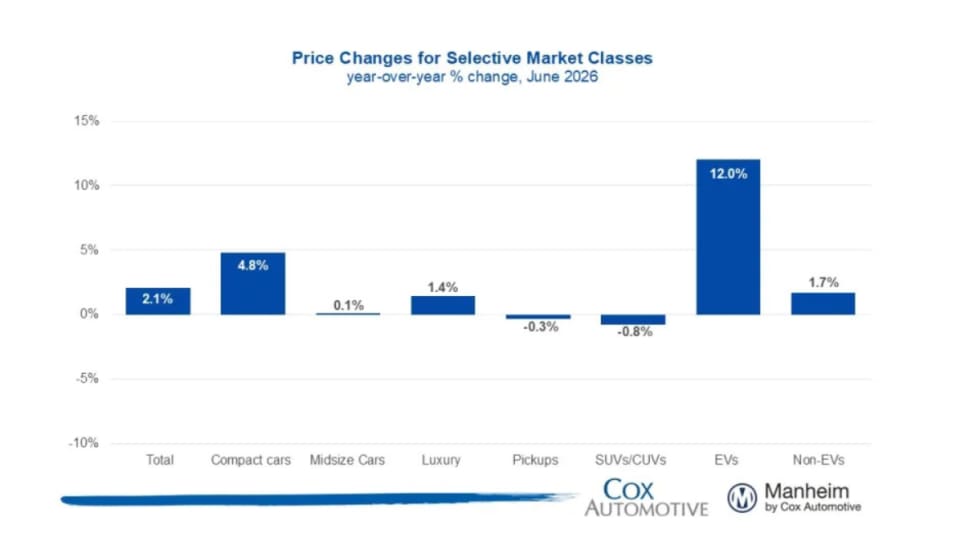
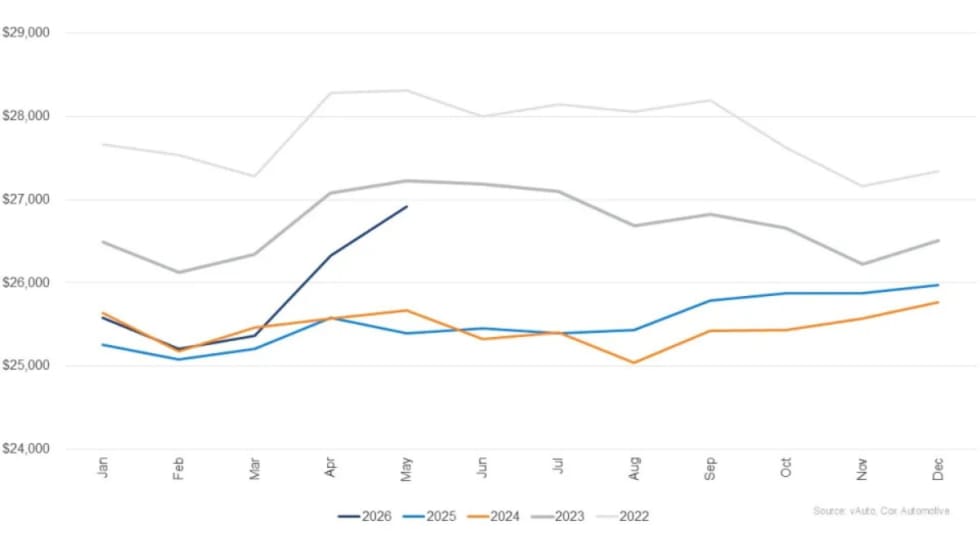
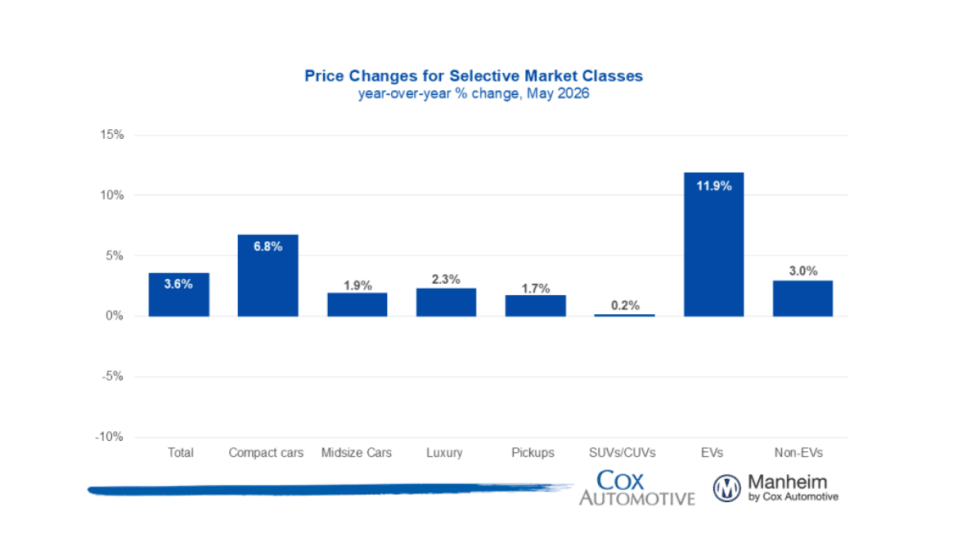
The market is seeing stronger appreciation in older used vehicles this year, and the most affordable segments have been among the year’s best performers.
The advantages and attributes of electric vehicles are upending the traditional remarketing cycle, requiring fleet sellers to rely on new factors and approaches detailed below.
The Iranian conflict and rising gas prices inject much uncertainty into the future wholesale used vehicle markets, as higher gas prices soak up spendable income from vehicle buyers.
The 2026 Conference of Automotive Remarketing convened with a mandate to involve a new constituency — fleet managers — and an updated mission to demonstrate unrealized value in de-fleeted vehicles.