




Related: AutoIMS Names CEO to Replace Broe
Fleet Vehicles Spending Fewer Days at Auction
Over the past three years commercial remarketers have cut the time it takes to sell a vehicle from the moment it arrives at auction by five days.
June 11, 2019

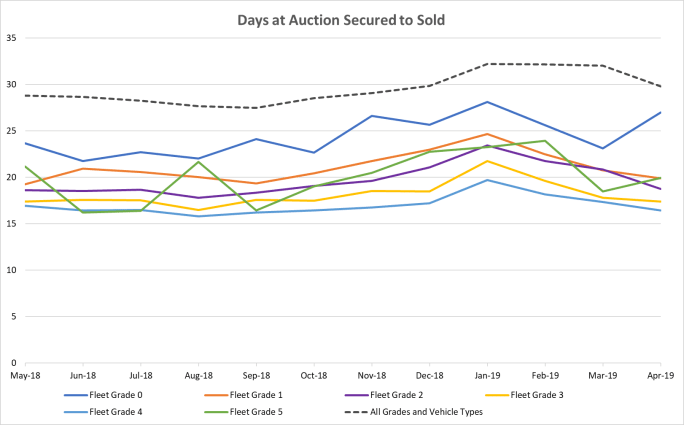
Within the fleet market, this pattern of highest time to sell being in January, followed by a gradual decline through the first half of the year is more-or-less the same every year, as evidenced by data from AutoIMS.
Graph via AutoIMS.
3 min to read
The average number of days a fleet vehicle stays at auction has gotten shorter over the past three years.
Over the past three years commercial remarketers have cut the time it takes to sell a vehicle from the moment it arrives at auction by five days, according to Joe Miller, VP client experience for AutoIMS.
"The old adage 'time is money' is as true now as it's ever been in the used vehicle space," said Miller. "A bevy of services introduced in recent years add data science to the art of selecting the right auction, performing the right repairs, and placing a floor price for each vehicle headed to auction — these decisions all impact a key metric: days to sell."
Looking at AutoIMS data shows that, through the first four months of 2019, it took the longest to sell a fleet vehicle in January 2019, at around 23 days. In the months that followed that number gradually fell, and landed at an average time of 20 days to sell a vehicle in April.
For the market as a whole, it took an average of 31 days to sell a vehicle in January. That amount of time stayed pretty much the same through March. In April that number declined to about 28 days to sell.
Within the fleet market, this pattern of highest time to sell being in January, followed by a gradual decline through the first half of the year is more-or-less the same every year, as evidenced by data from AutoIMS.
If 2019 follows the time-to-sell pattern of 2018, time to sell for commercial vehicles should continue to shrink until August, at which point time to sell will gradually rise until January 2020.
Comparing commercial time to sell versus the overall industry: commercial vehicles sell nearly 10 days faster than rest of the industry, according to Miller.
Graph via AutoIMS.
One factor playing a large part in average time to sell is vehicle grade, noted Miller. As might be expected, vehicles in poor condition take longer to sell than one in better condition. The average time it takes to sell a vehicle in poor to rough condition is 25 days. Vehicles in better condition take, on average, less than 25 days, according to Miller.
Cost/time benefit trade-off should be calculated carefully by fleets and constantly re-examined based on depreciation rates, buyer preferences, and other related factors, added Miller.
In terms of average sale price, fleet segment vehicles tend to sell for $1,500 to $2,000 less than the overall industry.
A reason for this is due to the high number of off-lease vehicles returning to the consumer market. These vehicles, on average, are better equipped and have lower mileage than fleet vehicles, and they tend to command a higher price point.
Looking forward, Miller said that the industry could still stand to see a larger reduction in days to sell. A five day reduction in time to sell over the past three years is a positive metric, but it's been mostly due to the industry's cyclical pattern working in its favor.
"The fleet segment follows a similar, cyclical pattern for days to sell throughout the year, but has not experienced the overall downward trend in total days that many would tout as a success over the past few years," said Miller.
Subscribe to Our Newsletter
More Fleet

Acertus Acquires Fisher Shipping, CEO to Join Acertus
Fisher Shipping will retain its brand and team, while its customers gain access to Acertus’ transportation, storage, vehicle care, and title and registration services.
Read More →
Commercial Fleet Sales Contribute To June, YTD Gains
The fleet sector has boosted its vehicle purchases at a reliable pace in the first half of this year compared with 1H 2025.
Read More →
Registration Opens for 2026 Fleet Forward Conference
Held on the East Coast for the first time, the Washington, D.C.-area event features expert-led education, a new IIHS Crash Test Experience, and collocation with the NAFA’s Fleet Safety Symposium.
Read More →
AP Fleet Management Expands Remarketing Program for Commercial Work Trucks
AP Fleet Management expanded its commercial vehicle remarketing program with dedicated resale services and an online marketplace for used work trucks.
Read More →
Used EVs Strengthen Overall Electric Vehicle Market
The latest sales data point to several reasons for the divergent trends in new and used EVs that can factor into fleet cycling decisions.
Read More →
Wholesale Used Vehicle Market Sustains Moderate Rise In Values, Prices
Trends continue to normalize after a strong start to the year, as consumers contend with higher gas prices in the coming summer months.
Read More →
Commercial Fleet Sales Still Lead Sectors Despite May Mini Dip
The U.S. economy's continued growth and positive business investment are creating a favorable environment for fleet vehicle demand.
Read More →
The Data-Driven Haul: 5 Ways AI is Leveling the Playing Field in Auto Transport
Large and small transport fleets are becoming more competitive as predictive analytics and real-time data inform the logistics decision chain.
Read More →
Commercial Fleet Sales Show Healthy Gains
So far, the fleet sector is outshining government and rental fleet sales this year as economic growth spurs more business investment.
Read More →
CAR 2026 Recap Part 2: Closing the Gap Between Data & Remarketing Value
The second half of CAR 2026 examined how fleets can translate lifecycle strategy, vehicle data, and market shifts into higher real-world results.
Read More →