



New Vehicle Supply Slumps to Record Low
Market watchers had been expecting this slowdown to come earlier in the summer, but deals could still be made. Now there just isn’t enough product available.

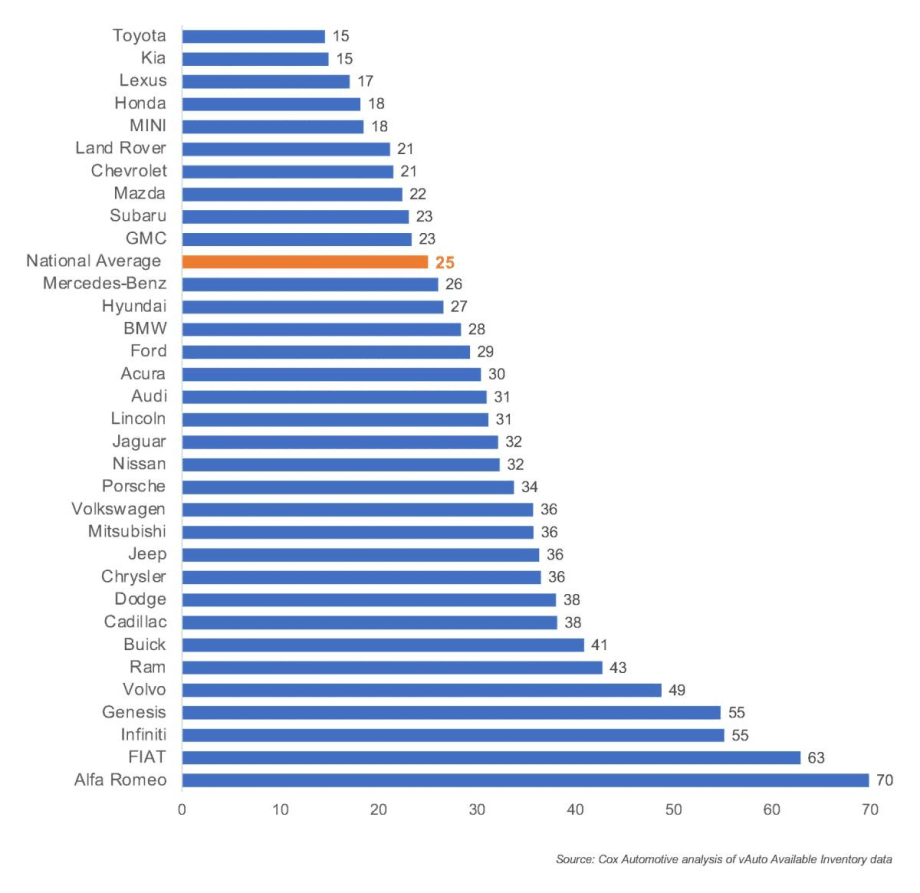
National number of days vehicle supply by brand.
Graphic: Cox Automotive
The U.S. auto industry entered July with historically low inventories that triggered record-high prices, according to a Cox Automotive analysis of the vAuto Available Inventory data.
The total U.S. supply of available unsold new vehicles stood at 1.13 million vehicles as June closed. That was down from 1.78 million vehicles at the close of May and 2.24 million at the same time in April.
Supply has been trending lower since mid-December. Inventory near the end of June was running 57% behind levels for the same period in 2020 and 70% below the same timeframe in 2019, according to a Cox Automotive analysis.
Days’ supply fell to a record-low 25 days, from 35 the previous month and 44 the month before that. Days’ supply near the end of June was running 64% below the same period a year ago.
Inventory of new non-luxury vehicles fell below 1 million units at 933,532 vehicles for a 25 days’ supply. That compares with 1.3 million vehicles for a 34 days’ supply a month earlier and 1.9 million vehicles for a 43 days’ supply at the end of April.
Inventory of luxury vehicles was 194,243 vehicles for a 31 days’ supply, down from 41 in the same period in May.
The Cox Automotive days’ supply is based on the daily sales rate for the most recent 30-day period. In June, new vehicle sales slowed from their earlier frenzied pace to a seasonally adjusted rate of 15.4 million vehicles, down from 17 million in May and 17.2 million in June 2020.
“The sales pace is definitely slowing, and limited supply is the likely cause,” said Charlie Chesbrough, Cox Automotive senior economist. “Market watchers had been expecting this slowdown to come earlier in the summer, but deals were still able to be made. Now, though, there just isn’t enough product available.”
Record-shattering prices may also be scaring off consumers. As July opened, the average listing price for new vehicles was $41,016, the first time it surpassed $41,000. The average listing price was 7% above the same period a year ago and 12% above 2019 levels.
For non-luxury vehicles, the average listing price was $37,637, up from $37,284 at the opening of June. For luxury vehicles, the average listing price remained above the $60,000 mark but, at $60,659, retreated from records set in recent months.
Kia Ties Toyota for Lowest Days’ Supply
Kia tied Toyota for the lowest days’ supply at a scant 15. The new Kia Carnival and always popular Telluride SUV had single-digit days’ supply – the lowest of all models. Toyota’s RAV4 SUV and Tacoma and Tundra pickup trucks had days’ supply under 15. Toyota again had several models with less than 20 days’ supply.
Honda joined the ranks of non-luxury brands with extremely low inventories, particularly of its new Civic, at 18 days’ supply. Mazda, which has cut production in Japan, was at the low end at 22 days. As usual, Subaru had low supplies, which clearly hurt its June sales. Chevrolet and GMC continued to have well-below average inventories. Chevrolet had numerous SUV and truck models with inventories below 20 days’ supply.
On the luxury side, Lexus once again was the brand with the lowest inventory at 17 days’ supply, but now, Land Rover is in a similar situation.
Minivans Rank Rock Bottom for Inventory
Once again, minivans saw the lowest inventories among segments. Stellantis’ minivan plant in Canada remains closed, as it has been for months. Kia’s new Carnival has single-digit inventories. Toyota’s new Sienna has scant supplies as well.
As has been the case for months, SUVs and crossovers of most sizes and price categories had lower-than-average inventories as July opened. Full-size truck inventory also was lower than average. Ram had enjoyed healthier supply than its rivals GM and Ford, but Stellantis was forced to trim its production this month.
At the other end of the spectrum, cars, especially large and luxury ones, had the highest inventories as well as electric vehicles and the smallest SUVs.
Across the price spectrum, the days’ supply ranged from 19 for the least expensive vehicles to 30 for vehicles in the $50,000 to $60,000 category.
More Fleet

Acertus Acquires Fisher Shipping, CEO to Join Acertus
Fisher Shipping will retain its brand and team, while its customers gain access to Acertus’ transportation, storage, vehicle care, and title and registration services.
Read More →
Commercial Fleet Sales Contribute To June, YTD Gains
The fleet sector has boosted its vehicle purchases at a reliable pace in the first half of this year compared with 1H 2025.
Read More →
Registration Opens for 2026 Fleet Forward Conference
Held on the East Coast for the first time, the Washington, D.C.-area event features expert-led education, a new IIHS Crash Test Experience, and collocation with the NAFA’s Fleet Safety Symposium.
Read More →
AP Fleet Management Expands Remarketing Program for Commercial Work Trucks
AP Fleet Management expanded its commercial vehicle remarketing program with dedicated resale services and an online marketplace for used work trucks.
Read More →
Used EVs Strengthen Overall Electric Vehicle Market
The latest sales data point to several reasons for the divergent trends in new and used EVs that can factor into fleet cycling decisions.
Read More →
Wholesale Used Vehicle Market Sustains Moderate Rise In Values, Prices
Trends continue to normalize after a strong start to the year, as consumers contend with higher gas prices in the coming summer months.
Read More →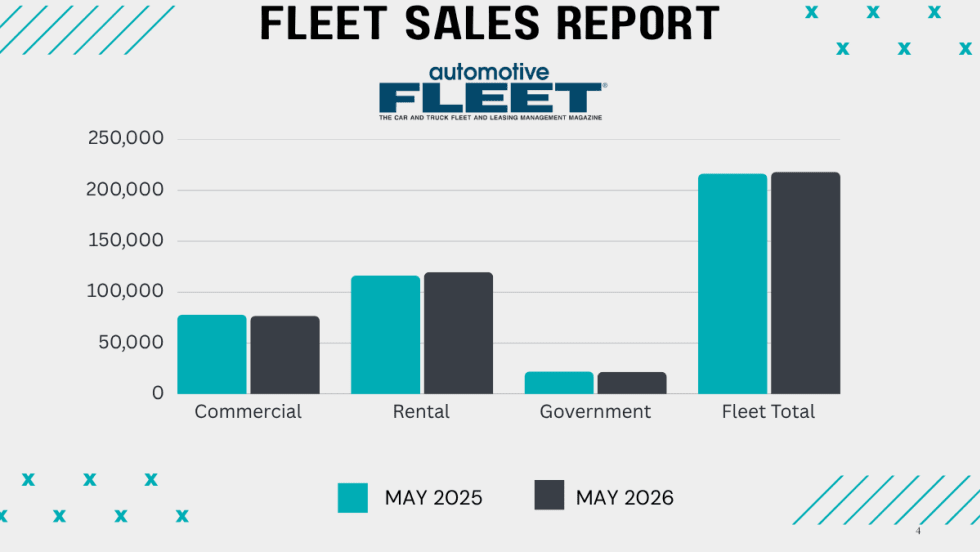
Commercial Fleet Sales Still Lead Sectors Despite May Mini Dip
The U.S. economy's continued growth and positive business investment are creating a favorable environment for fleet vehicle demand.
Read More →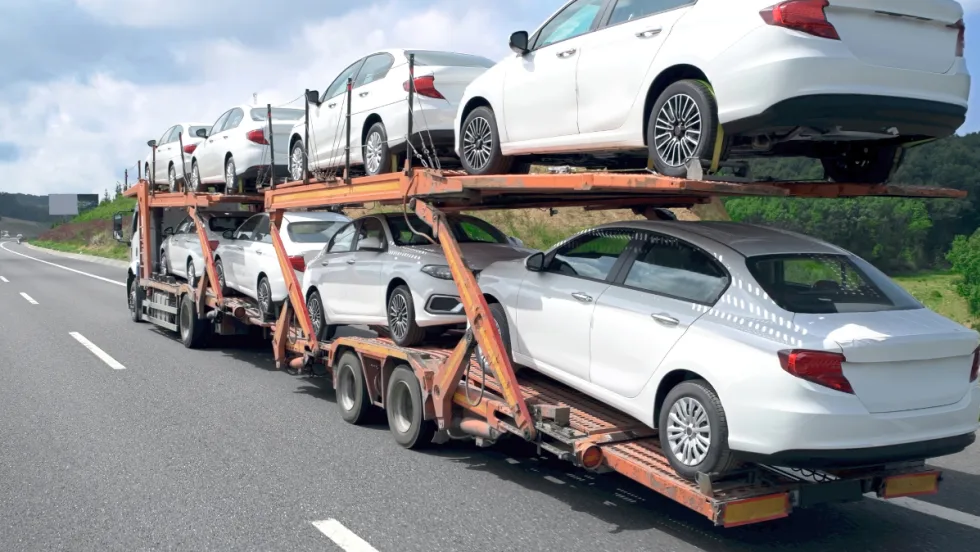
The Data-Driven Haul: 5 Ways AI is Leveling the Playing Field in Auto Transport
Large and small transport fleets are becoming more competitive as predictive analytics and real-time data inform the logistics decision chain.
Read More →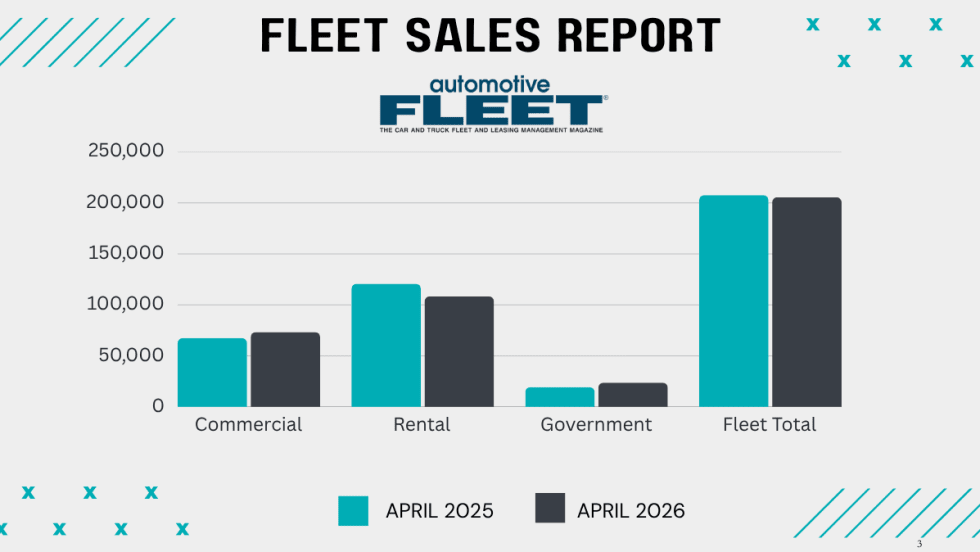
Commercial Fleet Sales Show Healthy Gains
So far, the fleet sector is outshining government and rental fleet sales this year as economic growth spurs more business investment.
Read More →
CAR 2026 Recap Part 2: Closing the Gap Between Data & Remarketing Value
The second half of CAR 2026 examined how fleets can translate lifecycle strategy, vehicle data, and market shifts into higher real-world results.
Read More →