



The Theory of Replacement
Peterson, Howell & Heather executive outlines replacement philosophy that can result in huge fleet savings.
The replacement of vehicles is one of the most important responsibilities of the fleet manager. And one of the most perplexing.
If the fleet manager replaces his vehicles too soon, it will cost his company money. Conversely, if he waits too long, it will again cost his company money.
David N. W. Grant Jr., vice president of Peterson, Howell & Heather, Baltimore-based leasing and fleet management company, said recently that the reason for sound replacement planning is two-fold. One reason is that salesmen require safe, modern, reliable transportation if they are to do their jobs efficiently. The other reason is to provide transportation at reasonable cost.
"You want minimum depreciation expense without incurring excessive maintenance cost," Grant said.
Speaking before the National Association of Fleet Administrators, Gant noted that different types of companies need different types of replacement programs.
"A company striving for sound management, and viewing the salesman as an important individual and his car plan as a personal benefit, will adopt a plan somewhat different than say, a government or a utility fleet, which does not or cannot share a philosophy centering on the human aspect rather than bare transportation and stark economy of operation," Grant said.
Simplest Method Not Best
According to Grant, the simplest replacement program-and the one requiring the least amount of analysis-is to replace a vehicle after a specific amount of time.
"It takes no wizard with the slide rule to count up how long the car has been in service, and come D-day, get out from under," Grant said. "This plan is easy to establish and administer but because simplicity is its only virtue, it is practically worthless. A car may be replaced with too little or too much mileage."
Another replacement program that has disadvantages, according to Grant, is the one that requires replacement after a specific number of miles have been chalked up-40,000, 50,000 or 60,000.
"The big fault with this plan is that the critical mileage may occur at an obviously bad time, for example, a month before new models are announced," he said. "The replacement car will be a full year old in 30 clays of service."
Turning to the combination replacement theory of replacing at a specific time or specific mileage, whichever comes first, Grant said it infers on the surface that the element which comes first is better.
"Inferred too is the mental exercise of determining which contingency will occur first," Grant said.
Replacing according to time alone, Grant said, imposes a restriction in one dimension-the time is right, but mileage can be anything. Replacing according to mileage alone imposes another restriction in another dimension-if mileage is right, then time can be anything.
'The 'either-or' approach imposes two restrictions: time not to exceed a certain mileage and mileage not to exceed a certain time," Grant said. "The end result is that excesses are avoided, but this program does not assure correct timing for effective utilization."
The PHHexecutive referred, to another replacement program which he called "no plan at all" or "the squeaking wheel principle."
"It takes over the vacuum created when fleet management abdicates its functions of management and does not announce and stand by a resolute, justifiable and equitable replacement policy," he said. "The squeaking wheel or squawking salesman gets the ear when he makes his presence known sufficiently. And, particularly if he should be a field sales manager that can happen at any time and at any mileage."
Grant said an operation research model of this approach "would look like you'd dipped a brush in a can of red paint, stood back a few feet and flicked."
PHH Replacement Philosophy
Grant then turned to the PHH replacement policy which he said "is the result of continuing analysis of markets and marketing techniques" and the "analysis of certain economic laws which are the facts of life insofar as the auto industry is concerned." The "economic laws" which dictate Peterson, Howell & Heather's replacement policy are:
1. Barring such unforeseen events as a national emergency, the resale value of a given car goes down each succeeding year. The important thing is that most of the decline in value from original cost occurs in the first year. There is a lesser drop in value the second year and still less the third year, so that the longer a car is in service, the lower the depreciation rate.
2. Conditions being equal, it is not mileage on a ear that determines its resale value, but its model age. A 1962 model placed in service last: August today is worth no more than a 1962 model delivered 10 months earlier. They are both one-year-old cars today and length of service isn't important.
3. With rare exceptions, the earlier in a model year, the higher the resale value. Conversely, the later in the model year a car is traded, the lower the resale value.
4. The cost of maintenance and repairs increases as mileage accumulates-and to a lesser extent, time.
5. Every replacement transaction involves not one, but to cars-the one being sold and the one purchased to replace the old car.
Using the above guidelines, Grant said that PHH has been able to develop a program for buying and selling cars that assures low depreciation. There is a definite season for buying and selling-a date is set after winch no transactions arc made-with the company replacing within season at a time which assures minimum depreciation over the long term. The key is replacing at a time which assures effective use of a car-neither too long nor too short-at a mileage which is neither too much nor too little.
"Viewing this program as an operations research program, we find replacement time for any ear accord-cording to mileage rate," Grant explained. "At one end of the scale is the very high-mileage car; at the other end is the very low-mileage car."
Under the PHH program, cars traveling more than 3,300 miles a month are replaced at 12 months, preferably at the beginning of the model year. Mileage at replacement is more than 40,000 miles.
Cars traveling between 2,500 and 3,300 miles a month are replaced at 18-month cycles, and they will have no less than 45,000 and no more than 60,000 miles.
Cars traveling between 2,000 and 2,500 miles a month are replaced on their second birthday, 24 months and they will have no less than 45,000 and no more than 60,000 miles.
Cars traveling between 1,500 and 2,000 miles a month are replaced at 30-month cycles, with no less than 45,000 and no more than 60,000 miles.
Cars traveling between 1,000 and 1,500 miles a month are replaced on their third birthday with a possible range of 36,000 to 54,000 miles.
Cars traveling less than 1,000 miles a month are replaced on their fourth birthday with a maximum of 48,000 miles.
Compute Mileage
Grant said that at the outset of a model year a fleet should compute the mileage of each car in service, with the mileage rate telling the season during which a car should be replaced.
The best way to determine if a ear is "in season" is its birthday, as it insures maximum service life within a model year consistent with the amount of built-in depreciation on the new car. Advancing or delaying the transaction increases the cost of one car or the other.
Grant said PHH used to recommend an annual trade prior to 1953, because a combination of depreciation and maintenance gave the best total result with replacement after a year. Over the years the company gradually extended maximum service lives from two, to three, and finally to four years aided by better quality.
"Twice we have changed policy right in the middle of the season," Grant continued. "One was in 1958, when we stopped all replacements of 1-year old cars, regardless of mileage. As it turned out, even excessive maintenance costs from high-mileage ears was more acceptable than sky-high depreciation from the sale of cars after only one year.
According to Grant, refinements during the last few years have led to departures from the strict birthday replacement formula. Certain cars that could not qualify for two years in service but should be kept more than one year, now fit into an 18-month cycle and result in more economy than a series of one or two-year old cars. Likewise with a 30-month cycle, midway between two and three years in service.
"Timing of cycle car replacements could lead to confusion, however; to keep replacements within the acceptable season means that the first of two would be placed in service at the beginning of the season, and would be replaced 18 months later as a one-year old," he said. Its replacement, however, would after another 18 months be replaced as a two-year old. Depreciation rates would be good on the first, not so good on the second-but averaged over the two cars would be better than three consecutive annual trades covering the same span of time."
To prove that the PHH program works, Grant used the year 1958 as an example-a year when the economic climate was unsettled and the used car market sliding, particularly on one-year-old cars.
"Since 1958, the depreciation rate of 1-year old ears sold at wholesale is higher by more than $7.50 per month. The depreciation rate of 2-year old cars sold has increased more than $10.50 per month. The depreciation rate of 3-year old cars sold has climbed more than $11 per month," he said.
A program based on length of service would, unless changed during the last five years, according to Grant, result in a depreciation rate combining ears sold after one, two, and three model years averaging some $8 to $12 more per month.
Originally posted on Automotive Fleet
More Fleet

Acertus Acquires Fisher Shipping, CEO to Join Acertus
Fisher Shipping will retain its brand and team, while its customers gain access to Acertus’ transportation, storage, vehicle care, and title and registration services.
Read More →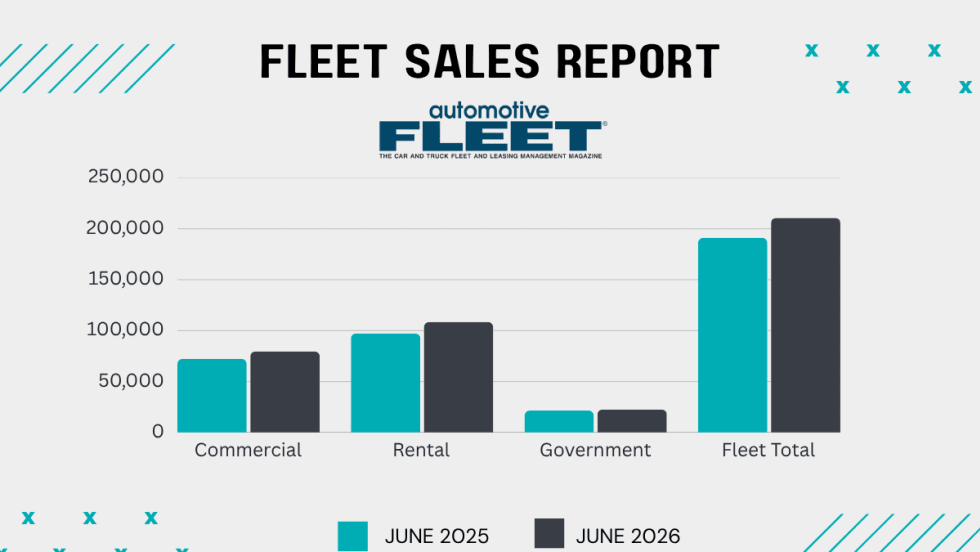
Commercial Fleet Sales Contribute To June, YTD Gains
The fleet sector has boosted its vehicle purchases at a reliable pace in the first half of this year compared with 1H 2025.
Read More →
Registration Opens for 2026 Fleet Forward Conference
Held on the East Coast for the first time, the Washington, D.C.-area event features expert-led education, a new IIHS Crash Test Experience, and collocation with the NAFA’s Fleet Safety Symposium.
Read More →
AP Fleet Management Expands Remarketing Program for Commercial Work Trucks
AP Fleet Management expanded its commercial vehicle remarketing program with dedicated resale services and an online marketplace for used work trucks.
Read More →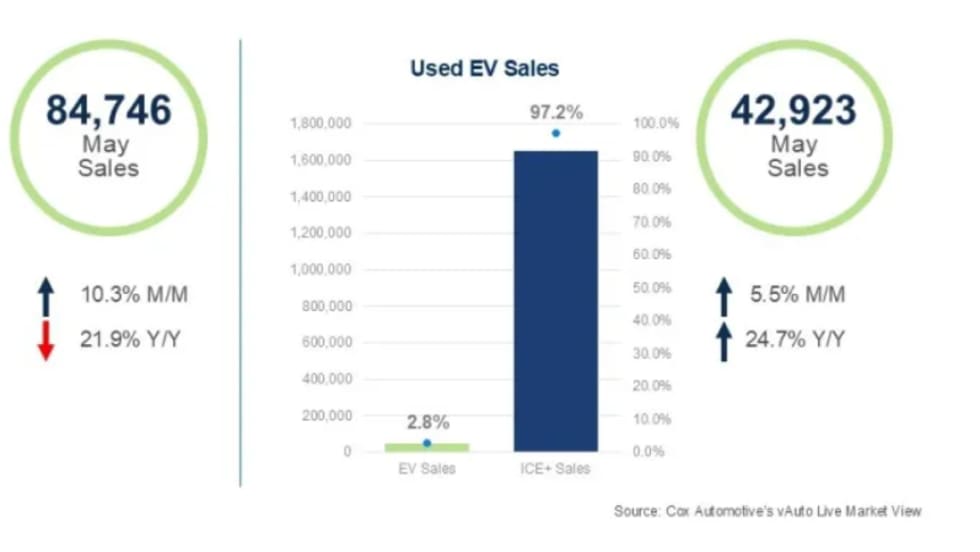
Used EVs Strengthen Overall Electric Vehicle Market
The latest sales data point to several reasons for the divergent trends in new and used EVs that can factor into fleet cycling decisions.
Read More →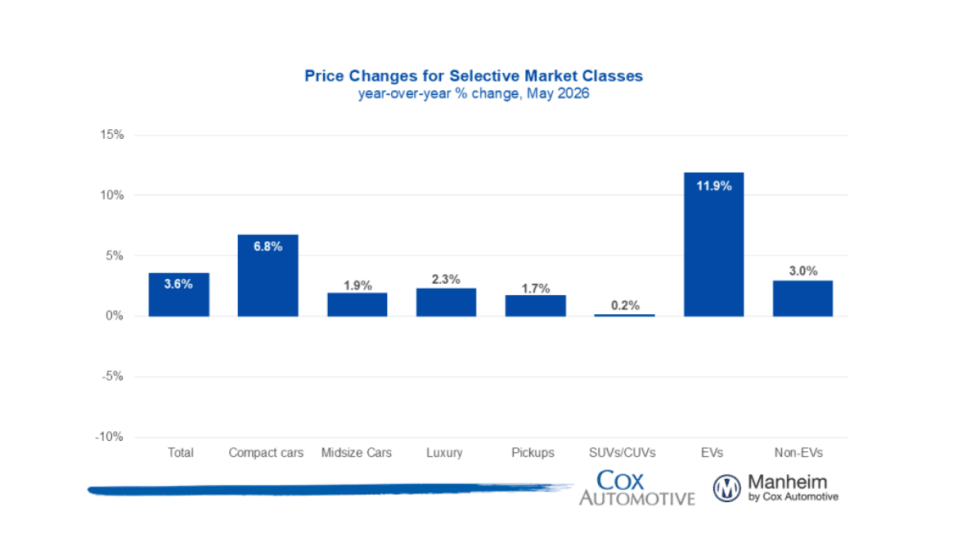
Wholesale Used Vehicle Market Sustains Moderate Rise In Values, Prices
Trends continue to normalize after a strong start to the year, as consumers contend with higher gas prices in the coming summer months.
Read More →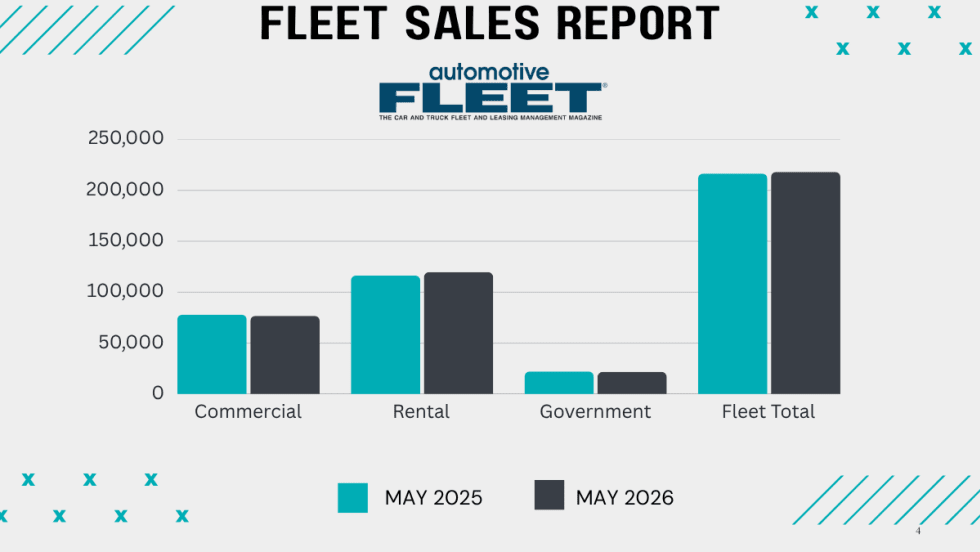
Commercial Fleet Sales Still Lead Sectors Despite May Mini Dip
The U.S. economy's continued growth and positive business investment are creating a favorable environment for fleet vehicle demand.
Read More →
The Data-Driven Haul: 5 Ways AI is Leveling the Playing Field in Auto Transport
Large and small transport fleets are becoming more competitive as predictive analytics and real-time data inform the logistics decision chain.
Read More →
Commercial Fleet Sales Show Healthy Gains
So far, the fleet sector is outshining government and rental fleet sales this year as economic growth spurs more business investment.
Read More →
CAR 2026 Recap Part 2: Closing the Gap Between Data & Remarketing Value
The second half of CAR 2026 examined how fleets can translate lifecycle strategy, vehicle data, and market shifts into higher real-world results.
Read More →