The Evolution of KAR Auction Services' Safety Program
By changing the structure and way its auctions operate; implementing a safety mascot inspired by Disney, and adopting a organization-wide culture of safety, KAR reduced its accident rates by 60%.
To reduce the likelihood of an accident, KAR set a standard procedure to stop a car 20 feet behind the car in front of it. To ensure that auctions could accommodate this new procedure KAR redesigned all lanes throughout its organization.
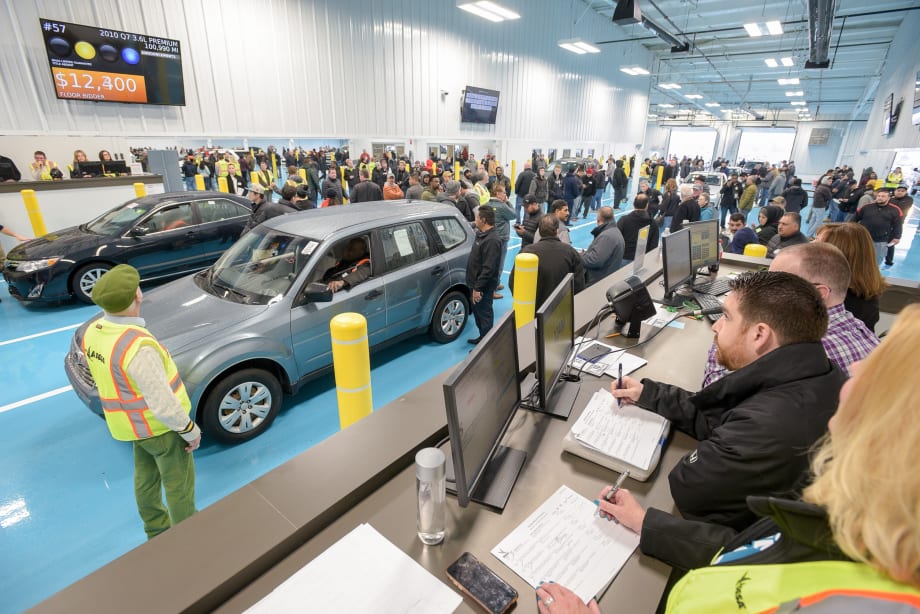
Photo courtesy of KAR Auction Services.
5 min to read
KAR Auction Services has reduced the rate of accidents at its ADESA locations by 60% over the past six years.
Total Incident Recordable (TIR)
Like all industries in the U.S., the auction industry is overseen by the Occupational Safety and Health Administration (OSHA). OSHA uses a matrix named TIR that measures the number of accidents for every 1,000 hours worked. The average TIR for the auction industry falls within 4 and 4.2. In 2013 KAR's auctions had a TIR number of 6.0. In 2018, its TIR number was 2.0.
This feat was accomplished through a number of initiatives: changing the way that physical auctions were structured and operated, implementing a safety mascot inspired by Disney, and adopting a safety culture throughout the company that asks that everyone from the CEO to the newest driver to do their part to ensure the safety of the business.
Ad Loading...
Although reducing accident rates at a business that operates nationwide and has over 70 physical auction locations atop hundreds of acres of land requires an entire organization to accomplish, David Vignes, president of Remarketing Services for KAR, has been at the head of the company's safety initiative for the past six years.
Redesigning a Line for Safety
When Vignes first began his initiative to make KAR auctions safer he took a close look at all the accidents on KAR properties over the past 10 years. In this analysis, he essentially created maps of every auction and put a dot on where an accident occurred.
What he quickly found out was that the risk hotspots — where a large majority of accidents occurred — were inside the barn, at the entrance, and at the exit of the building.
To address this KAR began to place rope at the entrance of the barn to ensure that there is rope around the cars and that the people do not walk in front of the car.
"As you can imagine, when you have a car going through the door of the building, if you have a pedestrian walking at the same time, it's a very tight space, so the rope helps with that," said Vignes.
Ad Loading...
The same was done at the exit of the building. Rope is placed to ensure that there is always a visible barrier between the vehicle and pedestrians. At the exit, vehicles are given an extra 10 or 30 feet of straight road before they turn, this way cars couldn't accidently hit pedestrians that were around the corner when exiting the barn.
Further analyzing inside the barn found another risk factor: the space between cars in lane. Vignes found that the space that drivers left between themselves and the car in front of them when stopping at the block was about six or seven feet.
"That's what's been done forever," Vignes said. "However, with that method, if for whatever reason a driver makes a mistake and pushes the accelerator when they meant to push the brakes; there is no time to react. If anyone would be between the two cars, that person would be crushed."
The standard procedure for KAR auctions was changed to put 20 feet between every car. To ensure that auctions could accommodate this new procedure KAR redesigned all lanes throughout its organization.
Now when a car sets up in front of the block where the auctioneer is, the next car has to be 20 feet behind. To avoid any mistakes, auction employees place a line on the floor so a driver knows exactly where to stop.
Ad Loading...
Employees also place two large posts on both sides of the car that can stop a car driving at 25 mph.
KAR also changed the flow at most of its auctions to remove left turns.
"We reorganized the flow of vehicles to eliminate intersection of cars and to be sure that drivers, as often as possible, only turn right," said Vignes. "Turning right is around five times less dangerous than turning left. FedEX and UPS were first to implement this, but we adopted it. We haven't been able to implement it at all locations, as some don't allow for only right turns. But, we have drastically reduced left turns."
Today there are only two locations where left turns have been mostly eliminated, Vignes noted. Most of his auctions have a redesigned flow that ensures that cars don’t cross each other on sale day.
Vignes said that KAR never hesitates to spend money to make a location safer, which technically means he doesn't have a set a budget for his role. He's still careful with money, but if a location like ADESA Boston needs a $650,000 investment to redesign the line in order to make it safer, he can move forward with that investment.
Ad Loading...
"It takes time and does not happen in one night," said Vignes. "It's by being consistent with the messaging and putting together tools for employees to speak up that will lead to progress."
Safe T. Sam's Influence in the Auction Industry
The mascot that emerged for KAR's safety program was Safe T. Sam. Having Safe T. Sam as a mascot for his safety program made the task of marketing KAR's safety program simpler. Any time that the company needed to get a message on safety out, it could associate the Safe T. Sam character with that message.
Photo courtesy of KAR Auction Services.
Vignes worked for the Walt Disney Co. for 15 years, and in that time he learned the power of a mascot.
When he started the safety program for KAR, he soon realized that if he could create a safety character that would resonate with people, it could help drive his safety message.
The mascot that emerged for KAR's safety program was Safe T. Sam. Having Safe T. Sam as a mascot for his safety program made the task of marketing KAR's safety program simpler. Any time that the company needed to get a message on safety out, it could associate the Safe T. Sam character with that message.
And, since its inception, the Safe T. Sam program has become nearly synonymous with safety in the auction industry.
Ad Loading...
As part of the Safe T. Sam program, all KAR employees — from CEO Jim Hallet to the newest driver — are required to watch a safety program every month. After watching the video, each employee needs to answer a questionnaire on those videos to ensure they've absorbed the knowledge from the video.
Vignes stated that among KAR's 18,000 employees, the compliance level for Safe T. Sam videos has reached over 99%.
This means that nearly all of KAR's employees are watching these videos, answering the questionnaires, and taking safety seriously.
At one point, Frank Hackett, CEO of the National Auto Auction Association, approached Vignes and asked for help to reduce the accident rates among the association's member auctions.
Vignes offered the Safe T. Sam program to the association and suggested that he offer the program to all of its independent auction members. The NAAA did just that, and last year, Manheim also agreed to follow the Safe T. Sam program.
Ad Loading...
As of May 2019, more than 82,000 auction employees throughout the industry have participated in Safe T. Sam training.
KAR hasn't had a fatality in one of its auctions in the last six years, and that's a statistic that Vignes is very grateful for.
The acquisition would expand Copart beyond its traditional salvage business into dealer-to-dealer wholesale remarketing while adding ACV’s vehicle data, inspection, and valuation technology.
The market is seeing stronger appreciation in older used vehicles this year, and the most affordable segments have been among the year’s best performers.
The advantages and attributes of electric vehicles are upending the traditional remarketing cycle, requiring fleet sellers to rely on new factors and approaches detailed below.
The Iranian conflict and rising gas prices inject much uncertainty into the future wholesale used vehicle markets, as higher gas prices soak up spendable income from vehicle buyers.
The 2026 Conference of Automotive Remarketing convened with a mandate to involve a new constituency — fleet managers — and an updated mission to demonstrate unrealized value in de-fleeted vehicles.
The enhanced technology allows rental car operations, dealerships, and auctions to compare a vehicle’s condition at pickup and drop-off within the same rental or loaner record.