



A Year of Variance & Prosperity in the Wholesale Market
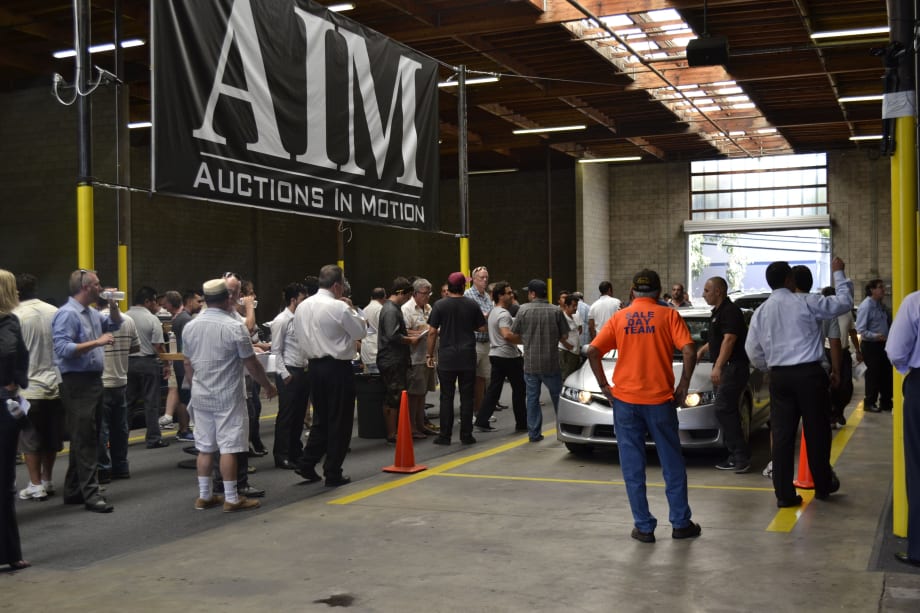
Overall used values were very strong in retention for the first half of 2012. Fleet remarketing teams continued to bring in better-than-predicted returns as they remarket out-of-service vehicles.
Overall used values were very strong in retention for the first half of 2012. Fleet remarketing teams continued to bring in better-than-predicted returns as they remarket out-of-service vehicles.
Overall used values were very strong in retention for the first half of 2012. Fleet remarketing teams continued to bring in better-than-predicted returns as they remarket out-of-service vehicles.
This year has brought the new and used auto industry quite a bit of variance from the previous calendar-year in vehicle volumes, retention values, and overall demand. Not only have retail consumer values been affected, but the purchasing and remarketing teams of the commercial fleets and fleet management companies have also had to adjust their efforts and expectations as 2012 progresses.
One example is the most popular used vehicle is not necessarily based on type, but more on age. The three- to five-year-old used vehicle hits a sweet spot in value these days with a still less than 100-percent confident consumer.
As Black Book looks at used-vehicle supply and how it is changing, this is a piece of the wholesale market we can have a good understanding of and how this is, and will be, affecting the used values today and going forward.
Strong So Far
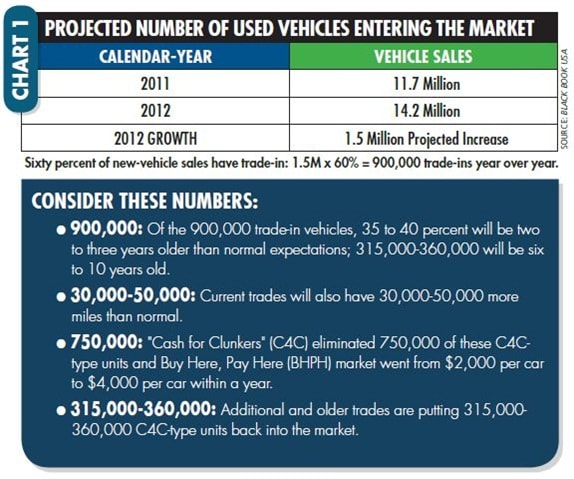
Overall used values were very strong in retention for the first five-and-a-half months of 2012. Fleet remarketing teams continued to bring in better-than-predicted returns as they disposed of out-of-service vehicles. Also, during the first half of 2012, the seasonally adjusted annual rate (SAAR) was much stronger than had been projected and also better than the actual new-vehicle sales from all of 2011. Even with the July 2012 SAAR at 14 million, which is down slightly from the running yearly average of 14.2 million, there will still be an expected increase of almost 900,000 more trade-ins during 2012 as compared to 2011. The bottom line is there is a significant increase in available used vehicles in the market over last year, the year before, and even during 2009.
Another area of interest is the difference in age and mileage of a good portion of these trade-ins as it compares to past years. We are at near-record levels for the average age of used vehicles on the road today. This is not only due to vehicles being better overall in quality and dependability, but mainly a result of buyers staying out of the new market over the past few years, as new-car sales plummeted from almost 17 million to 10.3 million in 2009 and 11.5 million in 2010.
Now that consumers are coming back into the market, their current trade-in is another two to three years older and has an additional 30,000-50,000 miles on the odometer than what the industry is accustomed to. Thus, the overall condition is lower and many of these units do not fit the level that many franchised dealers want to keep and retail. Who stands to benefit from this change in inventory mix?
Let’s take a journey back in time to when the government-backed “Cash for Clunkers” (C4C) program was in effect. The program did a great job of boosting sales of at least an additional 750,000 new vehicles during a short period of time. It also eliminated many less fuel-efficient, six- to 10-year-old vehicles with 130,000 to 250,000 miles. The availability of a $2,000 wholesale price over a year’s time jumped to a $4,000 to $5,000 wholesale value. Today’s trades are probably 35 to 40 percent former C4C type vehicles, so we are putting 315,000 to 360,000 of this type of used car back into the market this year versus last year. We anticipate this “Buy Here, Pay Here” (BHPH)-type car to make an adjustment in value over the next year and some piece of the industry will benefit from this change in the market supply. We are thinking that will be the BHPH dealer.
Is there a difference in the market between the three-year-old and the seven-year-old models, as a result of the slightly older trade-ins coming into the market? During July, the dollar level of overall change is greater on three-year-old models at -$376, while the 1.6-percent decline is less than the seven-year old, which was at -1.9 percent but a lower -$216 on the older models.
Breaking down segment depreciation, there were six segments where the older models had a larger percent depreciation than any of the three-year-old grouping. Over the past few years, the price of the one- to two-year-old used vehicle has been so strong in retention that, in many cases, it has been more cost effective to buy new. So, even as many vehicle values were increasing at times, the buyers in the auction lanes were hesitant to purchase the slightly used unit.
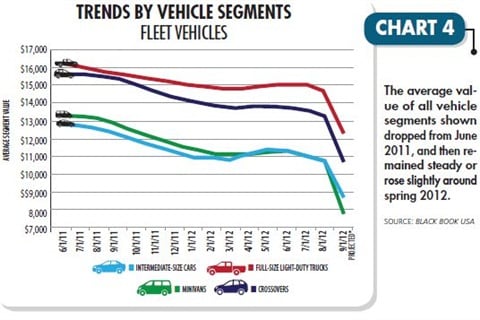
As 2012 has progressed, the level of change has increased. The seasonality effect where the market is preparing for an additional model-year of vehicles to appear is one driver of this, while the other is driven by the increasing supply of used vehicles. Whether the move is looked at as a percentage change or an actual dollar change, the resulting trends are the same.
As we look into the future in setting residuals and providing benchmarks for lenders in their portfolio, looking past the current strong used-vehicle market to a different retention scenario is a challenge that requires taking off the “blinders.” Notice in Chart 5 that three of the five truck segments shown had a larger monthly depreciation than quarterly change.
What’s Hot & What’s Not
Talk about fuel efficiency continues to be a major topic for the industry and consumers alike. From an industry and manufacturing point of view, the CAFE rules (35.5 mpg for 2016 and 54.5 mpg for 2025) are bringing more players into the very small car segment. These future regulations are also causing more players to enter the hybrid and electric markets. Neither of these segments are getting the demand that was anticipated in volume sold new, nor extra strong retention as used.
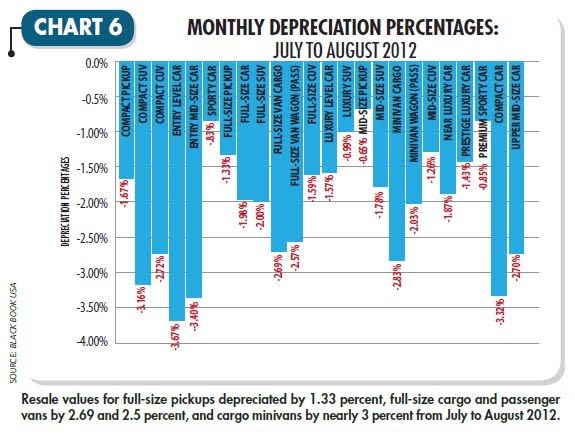
Last year at this time, Black Book reported that 11 of the 24 segment types tracked and reported by Black Book had declined by less than one percent from July 1 to Aug. 1. This year, only the luxury SUVs, mid-size pickups, and premium sporty cars can report that level of strength in 2012.
On the other end of the spectrum, last year Black Book reported six segment types with depreciation greater than the normal 1.4 percent to 1.8 percent. This year there were 14 in this greater depreciation group.
The Bottom Line
The economy is getting better even though there is still a struggling consumer confidence level we just can’t get completely over. Fleets are turning and replacing their inventory so the need for fresh vehicles is present. But, as the last new-car sales reports came out, a few of the major manufacturers lost market share and pointed the reasoning to limiting the vehicles for fleet, thus putting more challenges within the market. As you replace inventory from your fleet, don’t expect to continue to be the hero with positive cash flow versus projected levels of retention, but don’t worry about having to wave a flag of surrender either.
About the Author
Ricky Beggs is VP and managing editor for Black Book USA. He can be reached at rbeggs@blackbookusa.com.
Originally posted on Automotive Fleet
More Operations
The Data-Driven Haul: 5 Ways AI is Leveling the Playing Field in Auto Transport
Large and small transport fleets are becoming more competitive as predictive analytics and real-time data inform the logistics decision chain.
Read More →
How to Speak the Same Language on Fleet Safety
Drivers, supervisors, and data often speak different safety “languages.” Getting on the same page will drive better results.
Read More →
2026 CAR Awards Celebrate Industry Excellence
CAR’s annual Fleet Remarketing Awards opened a reimagined 2026 conference designed to bridge the worlds of fleet management and automotive remarketing.
Read More →
The Predictive Pivot: How AI and Data Are Redefining Auto Logistics in 2026
AI is no longer a luxury but the baseline for profitability in 2026. Auto haulers that adopt these tools now will quickly outpace those using manual workflows and taking a wait-and-see approach.
Read More →
The Predictive Pivot: How AI and Data Are Redefining Auto Logistics in 2026
AI is no longer a luxury but the baseline for profitability in 2026. Auto haulers that adopt these tools now will quickly outpace those that use manual workflows or take a wait-and-see approach.
Read More →
CAR 2026 Recap Part 2: Closing the Gap Between Data & Remarketing Value
The second half of CAR 2026 examined how fleets can translate lifecycle strategy, vehicle data, and market shifts into higher real-world results.
Read More →
CAR2026 in Two Words: Velocity, Value (Part 1)
The 2026 Conference of Automotive Remarketing convened with a mandate to involve a new constituency — fleet managers — and an updated mission to demonstrate unrealized value in de-fleeted vehicles.
Read More →
CAR 2026: Get the Wall Street Update on the Key Players in Remarketing
From a Wall Street analyst's take on remarketing's key players to whether fleets need their own version of Carfax, CAR 2026's afternoon roundtables will answer key operational and industry questions.
Read More →
CAR 2026 Session to Uncover the Missing Data That's Costing Fleets at Disposal
Work trucks lose value at remarketing, not because they aren't worth more, but because the data to prove it rarely makes it to the auction.
Read More →
TSD Mobility, UVeye Partner On Automated Vehicle Inspections
The enhanced technology allows rental car operations, dealerships, and auctions to compare a vehicle’s condition at pickup and drop-off within the same rental or loaner record.
Read More →